A maintainable multilingual store gives every language a crawlable URL, a complete customer journey and a clear relationship to the other versions.
Selling in more than one language is not only a translation project. It is also a page-structure, product-data and customer-journey project.
A product page can be beautifully translated and still fail in search if the language version has no crawlable URL, points its canonical to the wrong page, uses incomplete hreflang, or sends customers into a checkout written in another language. The opposite can also happen: the technical setup may be correct while the translation feels unnatural, misses local search terms or promises delivery rules that do not apply in that market.
DIRECT ANSWER. Use a separate crawlable URL for each language or market version. Keep one clear language on each page, translate the navigation, metadata and buying journey as well as the main copy, connect equivalent URLs with reciprocal hreflang, and use a canonical that matches the page’s real relationship. Give users a visible language switcher instead of forcing IP- or browser-based redirects.
This guide is for ecommerce owners, catalogue teams, marketers, developers and implementation partners preparing a multilingual or multi-regional store. It focuses on product, category, landing and blog pages—not only the homepage.
In this guide
The difference between multilingual and multi-regional ecommerce
What duplicate SEO problems actually look like
How to choose a stable language URL structure
What needs translation across the full customer journey
How hreflang, canonicals and x-default work together
How to keep product pages, structured data and product feeds consistent
A ten-step launch process, QA matrix and multilingual SEO checklist
How Bloomlytix can support a reviewed multilingual ecommerce workflow
Key takeaways
RULE | WHY IT MATTERS |
|---|---|
Use one crawlable URL per language | Search engines and users need a stable address for every version. |
Keep one main language on each page | Mixed or side-by-side language pages make the audience and page purpose unclear. |
Translate the buying journey, not only the description | Navigation, variants, delivery, checkout and policies affect both trust and conversion. |
Use reciprocal hreflang | Each version should point to itself and the other equivalent versions. |
Keep canonicals aligned with the real page relationship | Do not accidentally remove a translated page by canonicalising everything to English. |
Review every translation commercially | A fluent reviewer should confirm wording, product facts, search intent and local promises. |
Launch a controlled page family first | A tested product, category and policy set is safer than translating the whole catalogue at once. |
1. Multilingual and multi-regional are not the same
A multilingual website offers content in more than one language. A multi-regional website targets different countries or regions. A store can be one, the other, or both.
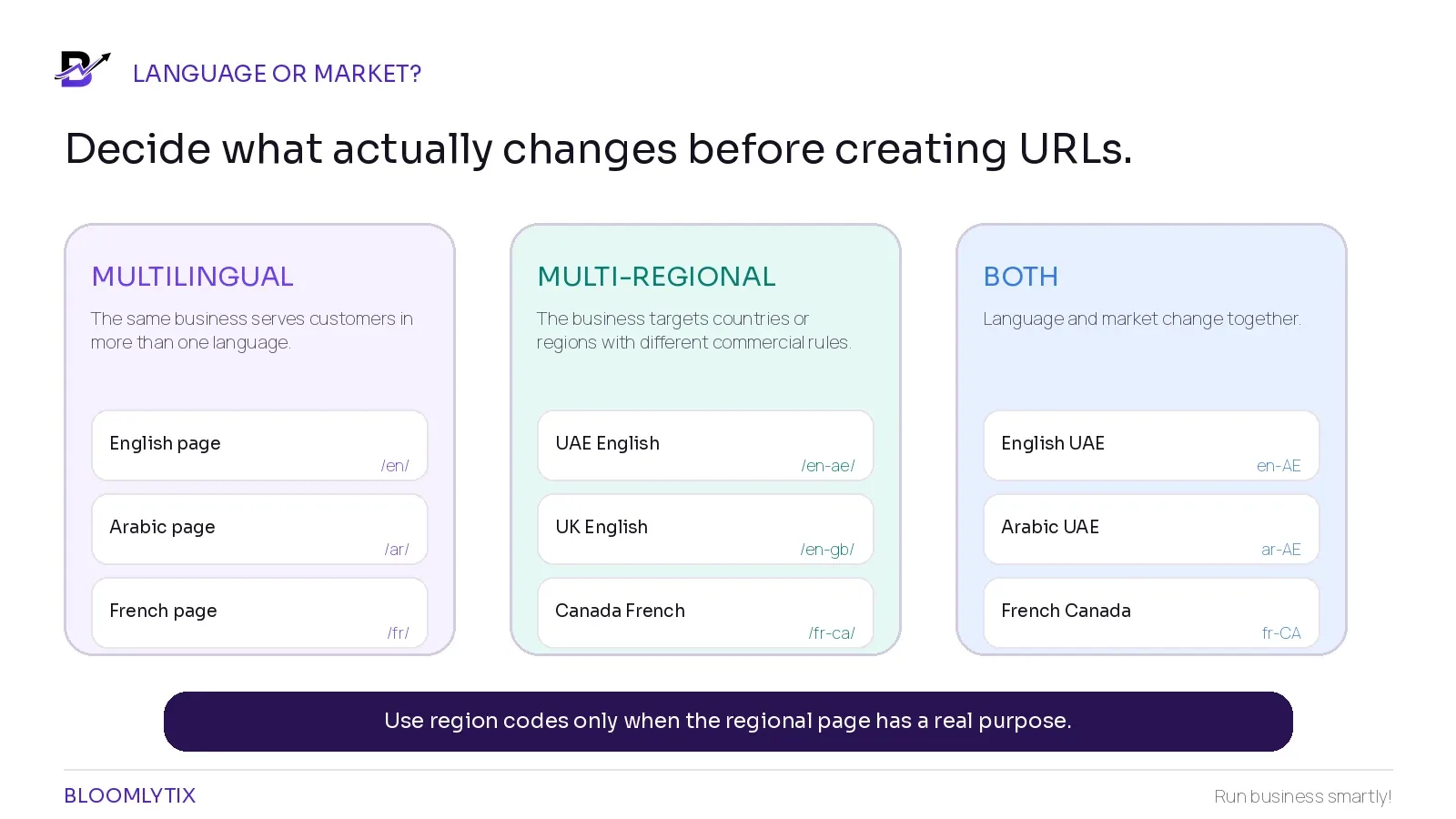
Figure 1. Use region-specific pages only when the regional version has a real commercial or operational purpose.
MODEL | WHAT CHANGES | EXAMPLE | USE IT WHEN |
|---|---|---|---|
Multilingual | The language changes while the commercial market is broadly the same. | /en/, /ar/, /fr/ | Customers need the same store experience in different languages. |
Multi-regional | Country, currency, delivery, tax, availability or policy changes. | /en-ae/, /en-gb/ | The business offer differs by market even when the language is the same. |
Both | Language and market change together. | /ar-ae/, /en-ae/, /fr-ca/ | The business needs local language and market-specific rules. |
PRACTICAL RULE. Use a region code only when the page genuinely serves that region. Creating en-AE, en-GB and en-US pages with almost identical copy and no commercial difference adds maintenance without helping the customer.
2. What “duplicate SEO problems” actually means
There is no automatic penalty simply because a business has similar pages. The real problems are uncertainty, wasted crawling and poor user experience. Search engines may choose the wrong URL as the main page, show the wrong language to a user, or spend time crawling page versions the business never intended to index.
PROBLEM | TYPICAL CAUSE | BUSINESS EFFECT |
|---|---|---|
Wrong-language result | The language versions are not connected clearly, or users are redirected before the crawler can access them. | A searcher lands on a page they cannot comfortably read. |
Translated page disappears | Every language page canonicalises to the English page. | The localised URL may lose independent search visibility. |
Several URLs show the same language | Parameters, session URLs, print pages or regional copies repeat the same content. | Search signals and crawl attention are split. |
Only the template is translated | Navigation changes, but the main product content remains in another language. | The page feels incomplete and may still be treated as duplicate content. |
Hreflang is ignored | Return links are missing, codes are invalid or URLs are not fully qualified. | Search engines cannot confidently map the alternatives. |
Local page makes the wrong promise | A literal translation copies delivery, returns, price or legal language from another market. | Customers see inaccurate commercial information. |
IMPORTANT. Translated pages are useful when the main content is genuinely translated. Translating only the header, footer or navigation while leaving the main page unchanged does not create a complete language version.
3. Choose a URL structure you can maintain
The URL is the permanent home of the page. Choose the structure before translating a large catalogue, because changing it later creates redirects, lost links and additional testing.
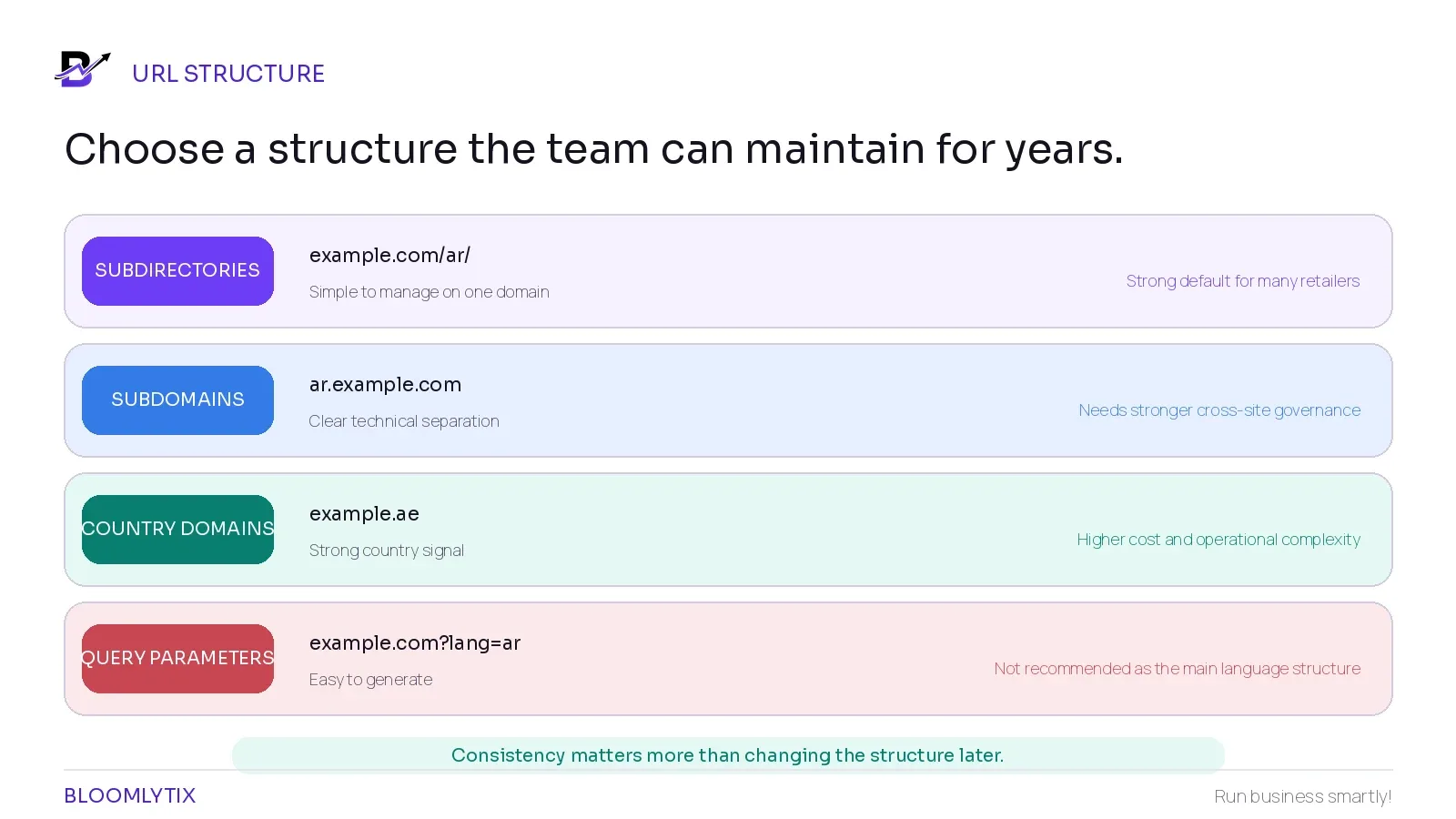
Figure 2. Subdirectories are a practical default for many retailers, but the right choice depends on governance and market needs.
OPTION | EXAMPLE | STRENGTHS | TRADE-OFFS |
|---|---|---|---|
Subdirectories | example.com/ar/ | One domain, simpler authority and maintenance, easy page-family mapping. | All markets share one technical platform and governance model. |
Subdomains | ar.example.com | Clear separation and independent deployment where needed. | More technical overhead and stronger cross-property governance. |
Country domains | example.ae | Strong country signal and market separation. | More cost, infrastructure, content and authority work. |
Query parameters | example.com?lang=ar | May be simple for application state. | Not recommended as the main indexable language architecture. |
For many small and mid-sized retailers, language subdirectories are the clearest starting point: /en/, /ar/ and /fr/. The business can keep one domain while giving each language a stable URL family.
URL RULE. Do not change the language only with a cookie, browser preference or JavaScript state while keeping the same URL. Search engines and users need a linkable page for each language version.
4. Map equivalent pages before translating
Do not translate pages one by one without a page map. First decide which source page matches which target-language page. The relationship should be clear for products, categories, landing pages, blog posts and policies.
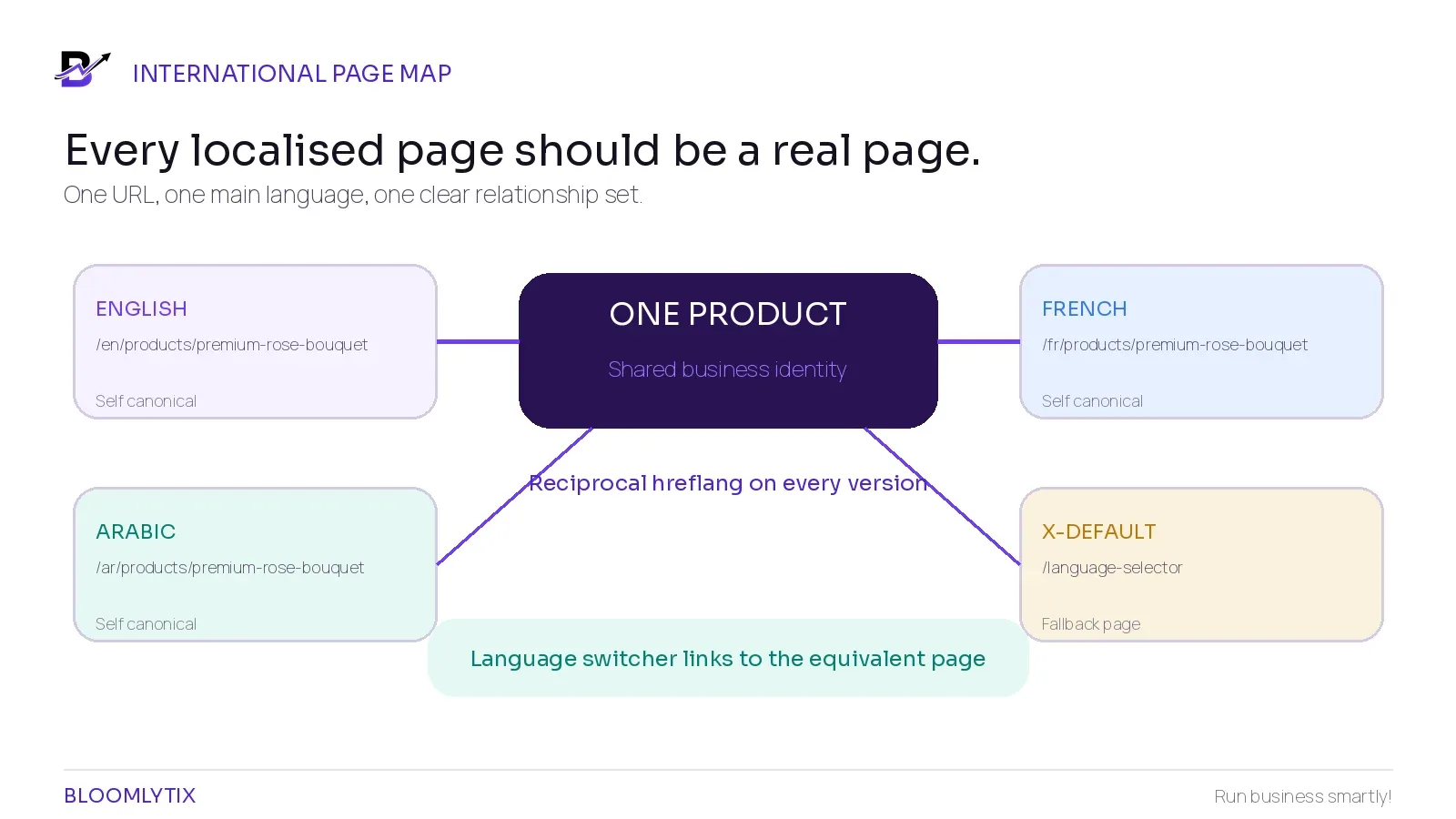
Figure 3. Every localised page needs a stable URL and a clear relationship to its equivalents.
PAGE TYPE | SOURCE VERSION | TARGET-LANGUAGE DECISION | DO NOT DO THIS |
|---|---|---|---|
Product page | Approved product identity, variants, images and facts. | Translate visible copy and keep price, stock and market rules connected to the real catalogue. | Create a new product identity only because the language changed. |
Category page | Products and filters in the source catalogue. | Translate category labels, introductions, filters and navigation. | Publish an empty translated category with no useful product access. |
Landing page | Campaign or occasion page. | Localise search intent, seasonal wording, offer terms and linked products. | Copy a market-specific offer into a country where it does not apply. |
Blog article | Educational source page. | Translate only when the topic helps the target audience; update examples and CTA. | Mass-translate every article without demand or review. |
Policy page | Returns, privacy, delivery or terms. | Use approved market-specific wording and legal review where required. | Machine-translate legal promises without verification. |
If a product is not available in one market, do not create a thin page simply to complete the hreflang set. Either omit that version, create a useful market-specific alternative, or route the customer through a clear category or language-selection experience.
5. Translate the full ecommerce journey
A product description is only one part of the page. The customer must be able to discover, understand, compare, buy, receive and return the product in the same language.
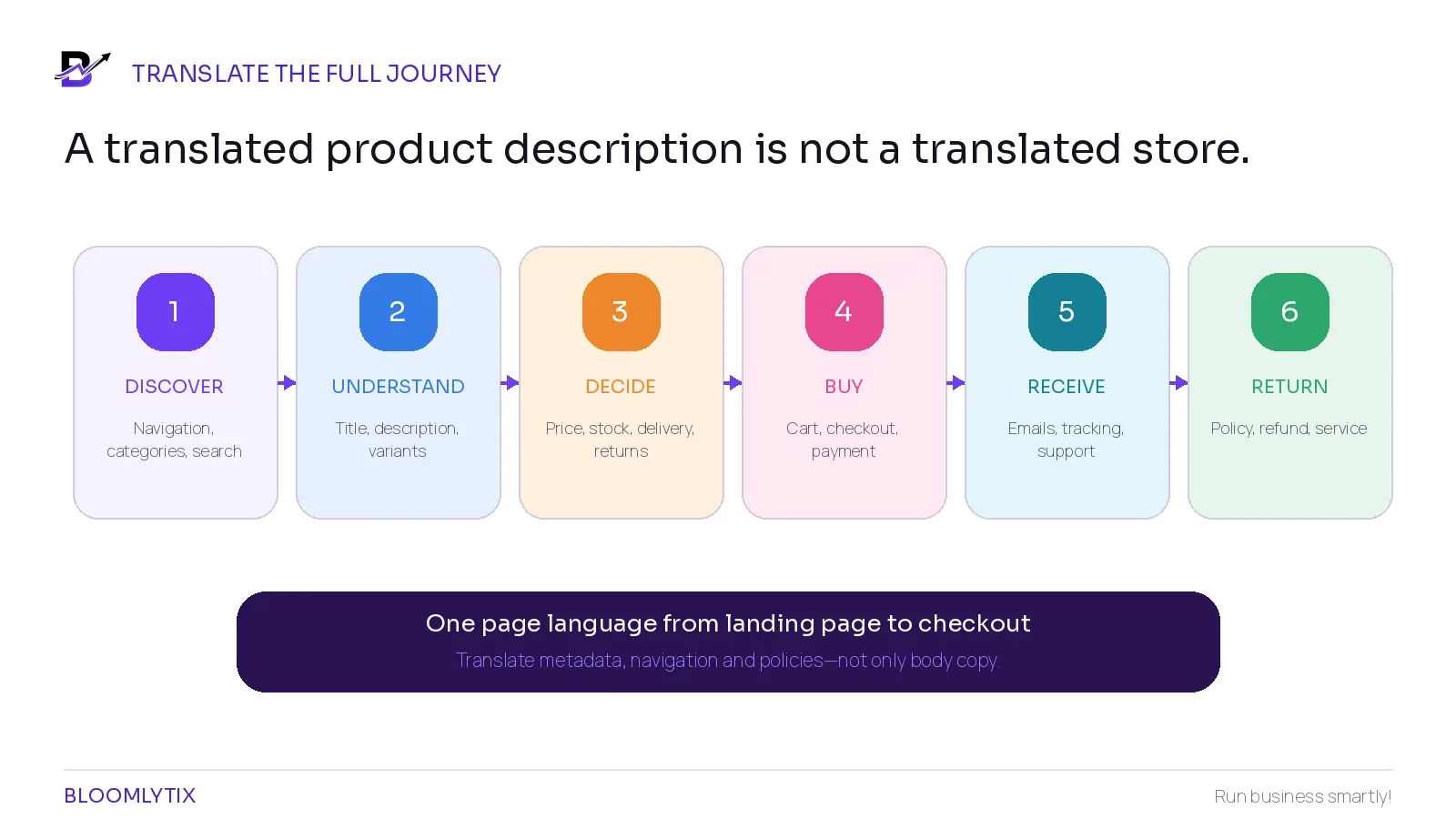
Figure 4. Translation should continue through the complete customer journey, not stop at the product description.
CUSTOMER MOMENT | TRANSLATE OR LOCALISE | COMMON FAILURE |
|---|---|---|
Discovery | Navigation, category names, search, filters, breadcrumbs and campaign labels. | The product is translated but users cannot find it through local navigation. |
Product understanding | Title, description, variant labels, size, quantity, materials, ingredients and included items. | The visible copy conflicts with the actual variant or product data. |
Commercial decision | Price, currency, stock, delivery promise, returns and trust information. | A page copies conditions from another market. |
Cart and checkout | Buttons, errors, address fields, delivery choices, payment guidance and policies. | The page changes language at the exact moment the customer must decide. |
Order fulfilment | Confirmation, tracking, pickup or delivery updates and support contact. | The customer receives messages in a different language from the order. |
After-sales | Cancellation, refund, return and service guidance. | The policy is understandable only in the source language. |
ONE-LANGUAGE PAGE. Use one main language for the page content and navigation. Avoid placing complete side-by-side translations on the same indexable page unless the page has a specific user need that justifies it.
6. Localise meaning, not only words
Translation asks, “What does this sentence say?” Localisation asks, “What should this page mean to this customer in this market?” The second question is more important for ecommerce.
AREA | WHAT A REVIEWER SHOULD CONFIRM | WHY LITERAL TRANSLATION CAN FAIL |
|---|---|---|
Search wording | The terms real customers use for the product, category or problem. | A direct translation may have little search demand or sound unnatural. |
Product name | Natural naming that still identifies the exact item and variant. | The translated title may become generic or change the product meaning. |
Measurements | Local units, decimals, sizes and quantity wording. | Customers may misread weight, volume or dimensions. |
Occasions and tone | Culturally appropriate gifting, seasonal and promotional language. | The same phrase can feel too formal, too casual or irrelevant. |
Claims and specifications | Exact approved meaning for ingredients, purity, materials, certifications and safety. | The translation may broaden a claim beyond the evidence. |
Delivery and policies | The correct areas, times, charges, returns and cancellation rules. | A global source page may promise conditions that do not apply locally. |
AI translation can reduce blank-page work, but it should remain a draft. A fluent reviewer should confirm the customer-facing language, while a product owner checks facts, pricing, variants, delivery and policy wording.
REVIEW RULE. If a sentence affects price, safety, compliance, stock, delivery, returns or customer expectations, the final wording must come from an approved business source and a qualified reviewer.
7. Add hreflang correctly
Hreflang tells Google that several URLs are language or regional alternatives of the same page. It does not create the translation and it does not replace a canonical. Its job is to map equivalent pages.
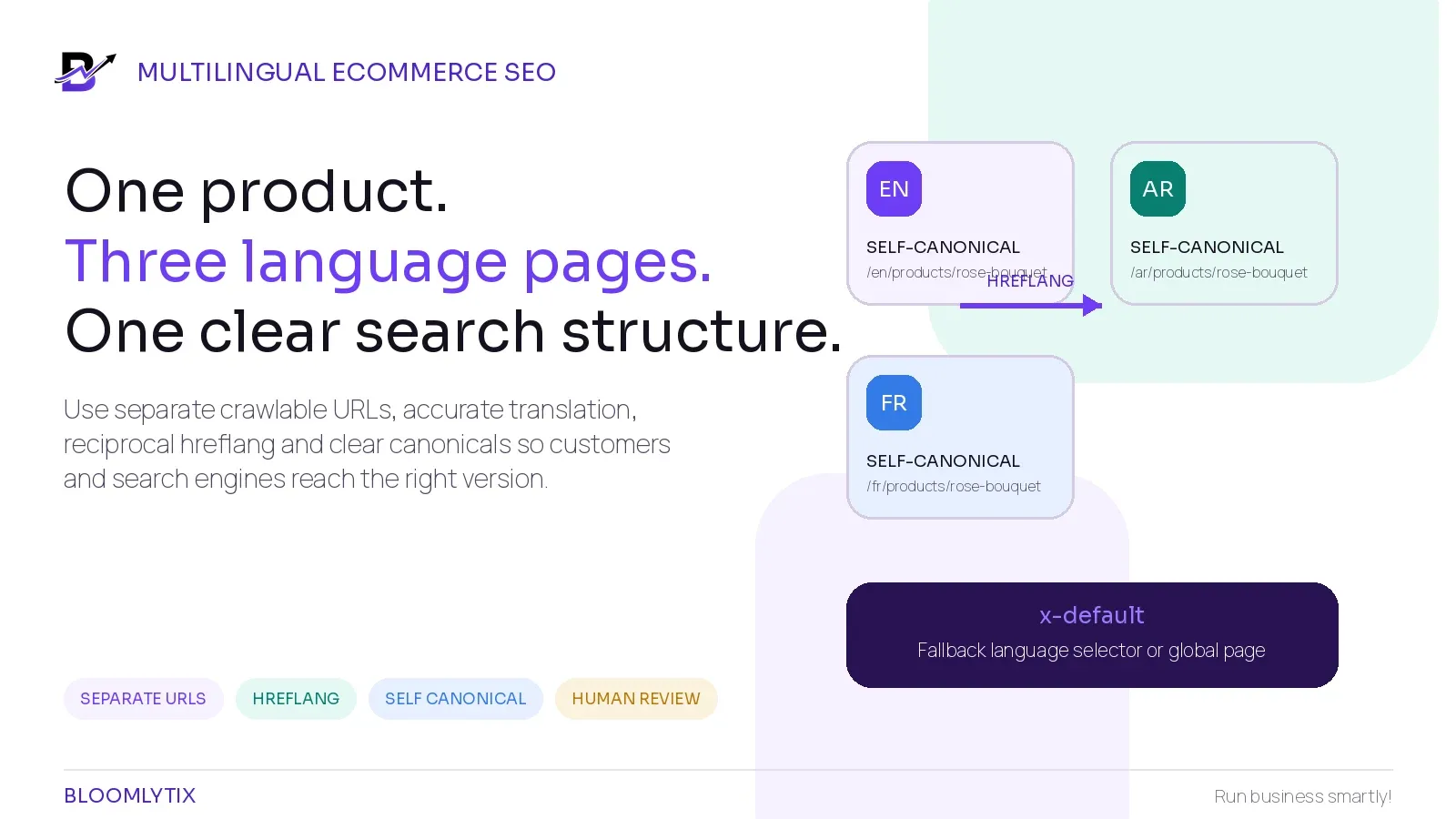
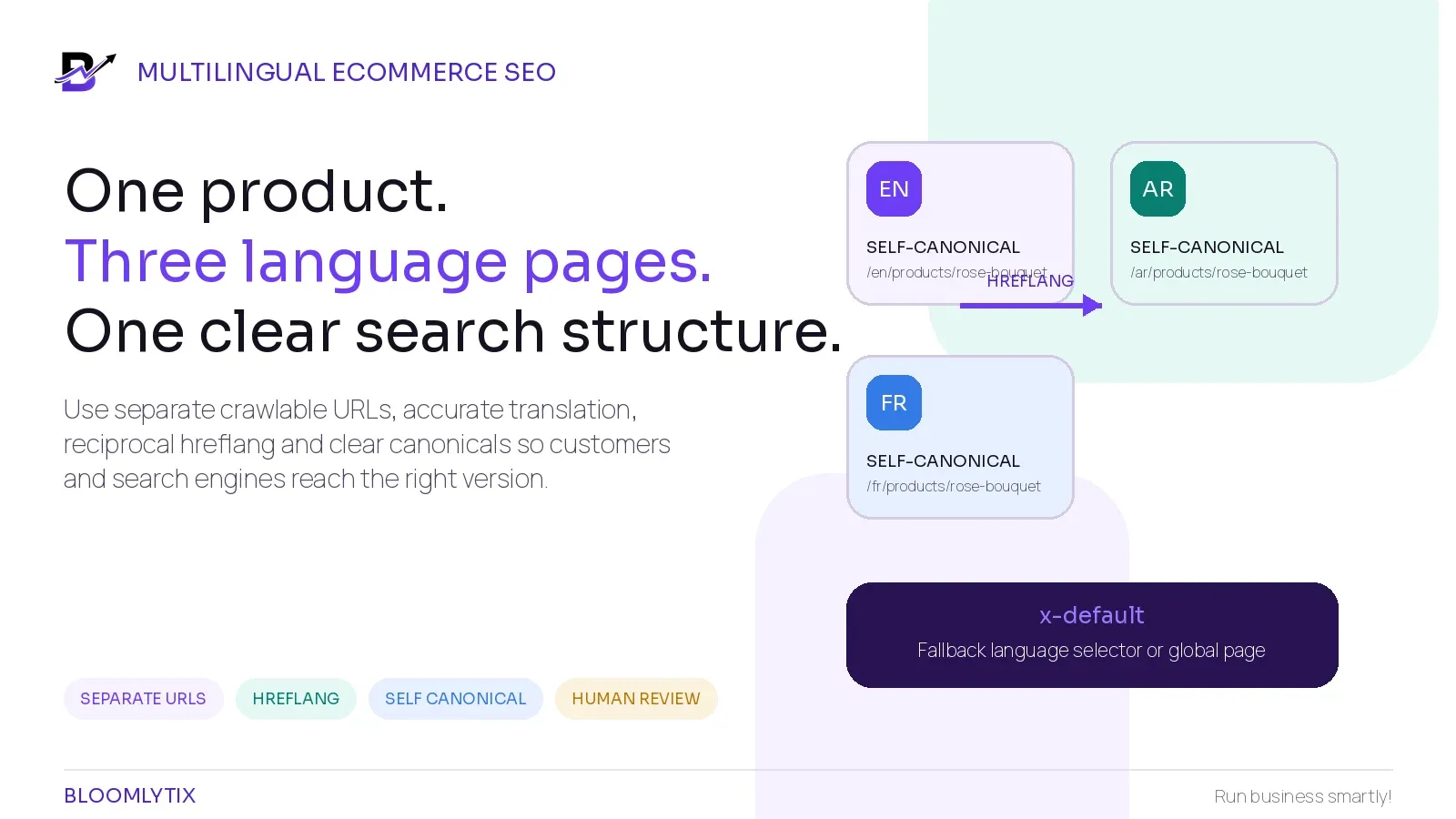
<link rel="alternate" hreflang="en" href="https://example.com/en/products/rose-bouquet" /> <link rel="alternate" hreflang="ar" href="https://example.com/ar/products/rose-bouquet" /> <link rel="alternate" hreflang="fr" href="https://example.com/fr/products/rose-bouquet" /> <link rel="alternate" hreflang="x-default" href="https://example.com/language-selector" />The same complete set should appear on the English, Arabic and French versions. Each page should include itself, and the pages must point back to one another.
HREFLANG RULE | GOOD IMPLEMENTATION | COMMON MISTAKE |
|---|---|---|
Use supported codes | Language first, with an optional region: en, ar, fr, en-GB, ar-AE. | Using a country alone, an underscore, or an invalid code such as en-UK. |
Use full URLs | https://example.com/ar/page | Using /ar/page or a protocol-relative URL. |
Include return links | Page A points to B, and page B points back to A. | Adding the relationship on only one language version. |
Include the page itself | Every version lists itself and its alternatives. | Leaving the self-reference out of the set. |
Use x-default when useful | A language selector or global fallback page. | Treating x-default as a replacement for a real language version. |
Choose one implementation method | HTML, HTTP headers or XML sitemap. | Maintaining several inconsistent implementations without a clear reason. |
Official reference: Google Search Central - localized versions of your pages.
8. Keep hreflang and canonicals aligned
A canonical identifies the preferred URL when several URLs show duplicate or near-duplicate content. Hreflang identifies language or regional alternatives. These signals should tell the same story.
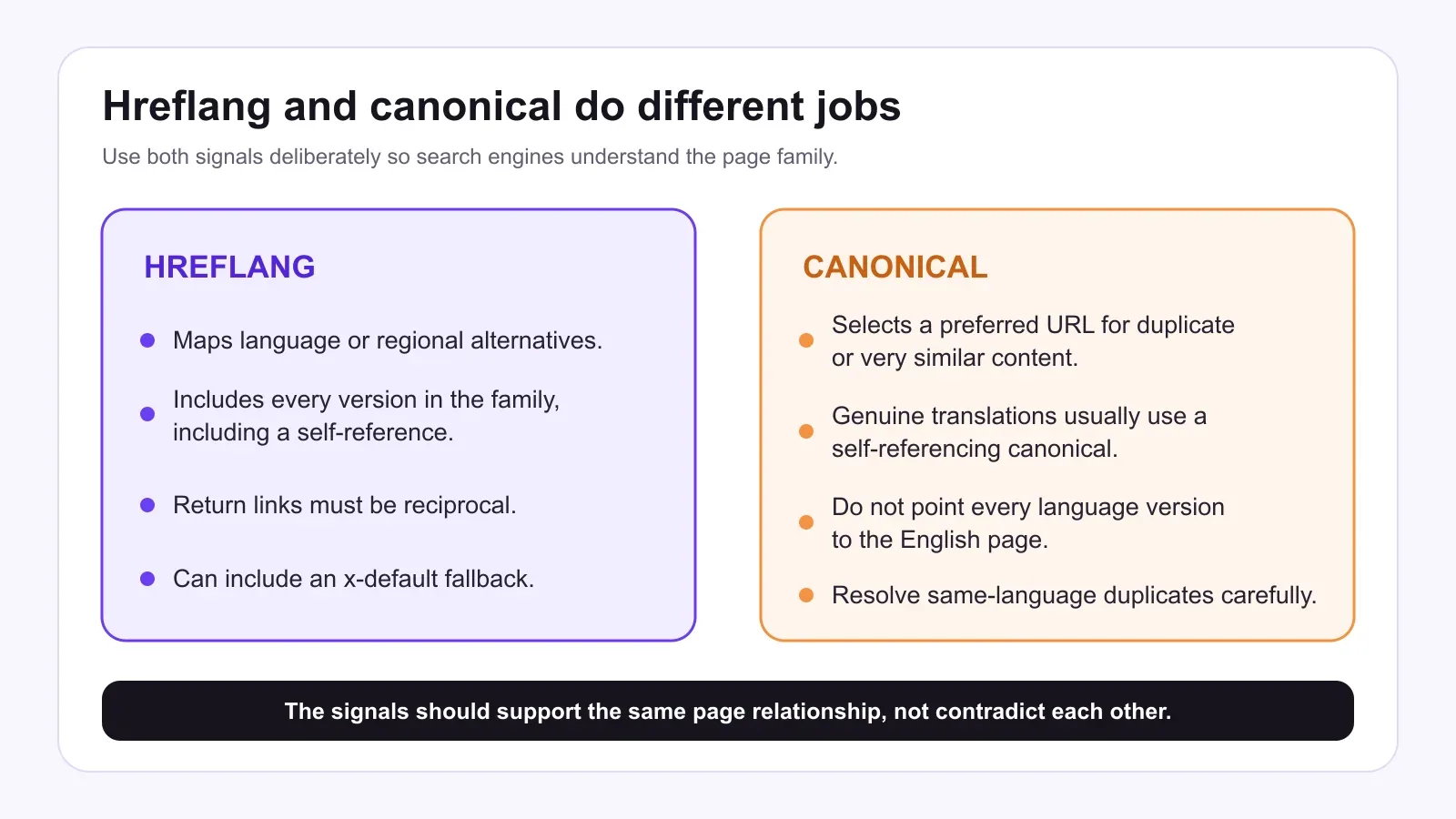
Figure 5. Hreflang maps alternatives; canonical resolves duplicate or near-duplicate URLs.
PAGE SITUATION | CANONICAL APPROACH | HREFLANG APPROACH |
|---|---|---|
Fully translated page | Use a self-referencing canonical on the translated URL. | Connect it to the equivalent language versions. |
Same-language regional pages with meaningful differences | Use self-canonicals when each page is a genuine local version. | Use language-region codes such as en-AE and en-GB. |
Near-duplicate same-language regional pages | Choose the preferred representative according to the canonical plan. | Use hreflang to communicate the regional alternatives. |
Tracking, sort or print URL | Canonical to the clean primary page. | Do not create hreflang sets for unnecessary URL variants. |
Language page canonicalised to English | Usually incorrect for a genuine translation. | The hreflang and canonical signals conflict. |
DO NOT DO THIS. Do not put a self-referencing hreflang on an Arabic page while canonicalising that same Arabic page to English. The page family should have one coherent URL plan.
Official reference: Google Search Central - canonical URLs.
9. Let users switch language without trapping them
A visible language switcher helps customers and crawlers reach every version. It should link to the equivalent page—not always return the customer to the homepage.
CONTROL | RECOMMENDED APPROACH | AVOID |
|---|---|---|
Language switcher | Use normal crawlable links and show the current language. | A JavaScript-only menu with no accessible href links. |
Equivalent page | Link English product A to Arabic product A where that page exists. | Sending every switch to the Arabic homepage. |
Automatic redirection | Offer a suggestion and remember the user’s choice where appropriate. | Forcing a redirect based only on IP or browser language. |
Missing translation | Explain the nearest available option or omit a false equivalent. | Linking unrelated pages only to complete the hreflang set. |
Arabic or RTL presentation | Use correct document language, direction, layout and form behaviour. | Mirroring only the text while leaving the interface unusable. |
Google normally crawls without relying on a user’s language preference and often from the United States. If the site changes content only after detecting location or browser language, some versions may be difficult to discover.
Official reference: Google Search Central - multi-regional and multilingual sites.
10. Keep ecommerce data consistent in every language
Multilingual SEO becomes an ecommerce problem when the visible page, catalogue, structured data, product feed and checkout disagree.
DATA AREA | WHAT MUST AGREE | LAUNCH CHECK |
|---|---|---|
Product identity | Product, variant, SKU or GTIN should identify the same sellable item in every language. | Compare the source and target product record. |
Price and currency | Visible page, structured data, product feed and checkout must show the approved value. | Run a real cart and checkout test. |
Availability | Stock or made-to-order status should match the market and branch rules. | Check an available and unavailable variant. |
Variant labels | Size, colour, scent, flavour or finish should be fully translated and mapped to the correct variant. | Switch variants and confirm URL, price and stock behaviour. |
Delivery and returns | The target market’s delivery, pickup, refund and return rules should be visible in the same language. | Follow the page through checkout and policy links. |
Structured data | Text and commercial properties must match the visible page. | Validate Product markup and compare rendered values. |
Merchant Center data | Feed language should match the product landing page and buying journey. | Check feed diagnostics for language, price and availability issues. |
If the business submits a French product data source to Google Merchant Center, the linked landing page and the customer’s buying journey should also be in French. The product data, page, currency and checkout should not contradict one another.
Official reference: Google Merchant Center - landing-page requirements.
Official reference: Google Search Central - product structured data.
11. Build language-specific navigation and discovery
Search engines find pages through links. A translated product page should sit inside a translated category and navigation structure, not exist as an isolated URL that only appears in a sitemap.
Link the language homepage to localised category pages, and categories to localised products.
Use descriptive anchor text in the target language.
Keep breadcrumbs, related products and article links inside the current language where practical.
Include canonical URLs in XML sitemaps and use accurate lastmod dates after meaningful updates.
If hreflang is implemented in the sitemap, validate that every page family uses the same complete relationship set.
Do not allow internal search, filter parameters or tracking URLs to create unnecessary indexable copies.
DISCOVERY RULE. A page that exists in the database but is not linked from the language navigation is difficult for both customers and crawlers to treat as part of a complete store.
12. A practical ten-step launch workflow
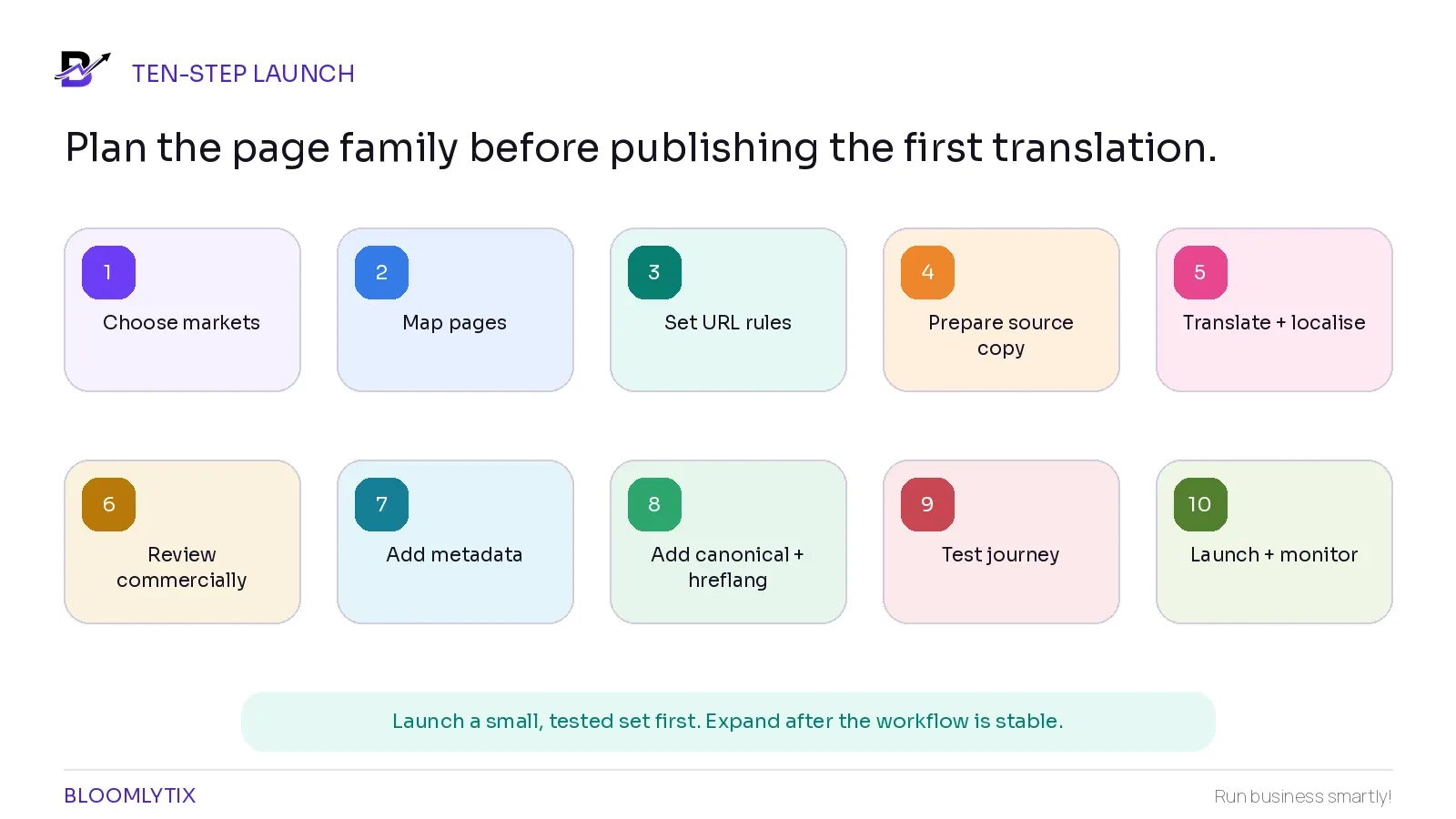
Figure 6. Build a controlled page family first, then expand after the workflow is stable.
1. Choose the language and market scope Decide whether the launch is language-only, region-only or both. Confirm currency, products, delivery, tax and policy differences.
2. Create the page map List source URLs and the exact target-language equivalents for products, categories, landing pages, blogs and policies.
3. Set the URL rules Choose subdirectories, subdomains or country domains. Define slug, redirect, canonical and language-switcher behaviour.
4. Prepare the source page Fix weak product data, duplicated titles, missing images, inaccurate policies and unstable URLs before translating them.
5. Translate and localise Translate the visible journey and adapt search wording, measurements, occasions and market-specific promises.
6. Run fluent and commercial review A language reviewer checks natural wording; product, operations and legal owners check the facts they control.
7. Add metadata and page signals Prepare local title, meta description, alt text, structured data, canonical and the full hreflang set.
8. Connect navigation and sitemaps Add crawlable language links, category paths, related pages and canonical URLs to the sitemap.
9. Test the real buying journey Open product variants, cart, checkout, delivery, email, support and return paths on mobile and desktop.
10. Launch, inspect and monitor Inspect representative URLs, submit meaningful changes, review indexing, queries, feed diagnostics and conversion by language.
13. Test search, language and commerce together
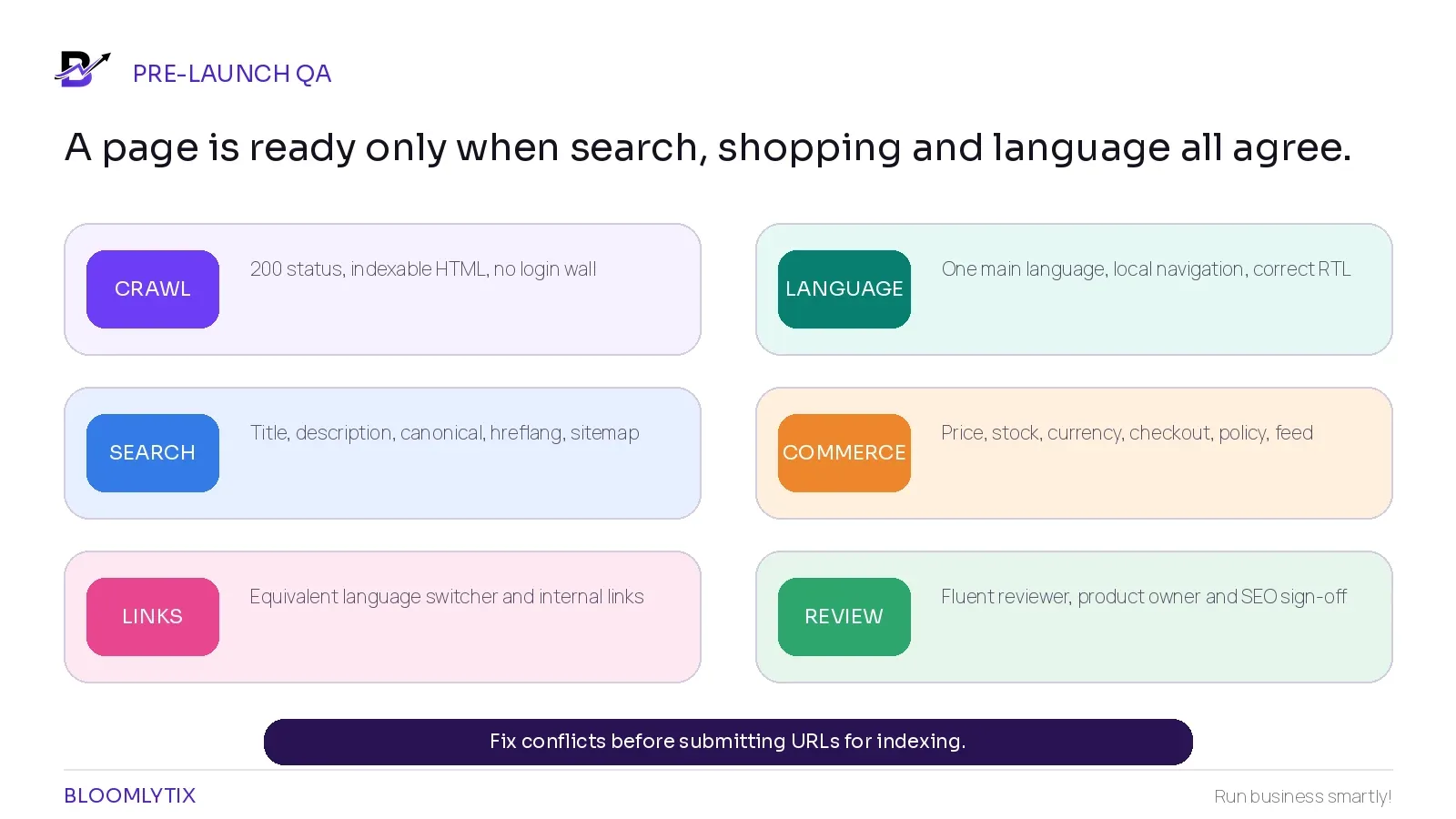
Figure 7. Search, shopping and language checks should be completed in one launch process.
AREA | PASS CONDITION | FAILURE TO CATCH |
|---|---|---|
HTTP and indexing | The language URL returns 200, is indexable and renders the complete page in public HTML. | A translated route that needs login, returns an error or is blocked by robots. |
Page language | Visible content, navigation and key actions use one clear language. | Mixed-language buttons, filters or checkout fields. |
Canonical | The canonical matches the approved page relationship. | Every language page canonicalises to English. |
Hreflang | Complete, reciprocal, fully qualified and valid language codes. | Missing return links or invalid codes. |
Language switcher | Links to the equivalent page and remains usable on mobile. | Users are forced to a homepage or a broken route. |
RTL and accessibility | Arabic layout, form direction, focus order and readable contrast work correctly. | Text is translated but the interface is not usable. |
Product data | Title, variants, price, stock and delivery match catalogue and checkout. | The translated page shows stale or market-wrong information. |
Structured data and feed | Visible page, markup and Merchant Center data agree. | Different language, currency, price or availability. |
Internal links and sitemap | The page is reachable through local navigation and listed correctly. | An orphan page known only to the translator. |
Human review | SEO, product and fluent-language reviewers approve the page family. | Technically valid pages with inaccurate or unnatural content. |
14. Measure quality by language and market
Do not judge the launch only by the total number of translated pages. Measure whether the right pages are indexed, shown to the right audience and helping customers complete useful actions.
METRIC | WHAT IT CAN REVEAL | USEFUL REVIEW |
|---|---|---|
Indexed URLs by directory | Whether the language sections are being discovered and selected correctly. | Compare expected and indexed page families. |
Queries and impressions by language | Whether local search wording matches the page. | Improve titles, headings and copy from real demand. |
Wrong-language landing rate | Whether users frequently land on a version they immediately switch away from. | Review hreflang, redirects and language detection. |
Language-switcher use | Where customers need another version or cannot find an equivalent. | Check page mapping and switcher placement. |
Product-feed diagnostics | Language, price, availability or landing-page mismatches. | Fix source data rather than changing only the feed. |
Engagement and conversion | Whether the localised page supports product understanding and checkout. | Review copy, trust, price, delivery and payment—not only rankings. |
Support questions | Repeated confusion about product facts, delivery, returns or language. | Update the page and workflow. |
MEASUREMENT NOTE. Hreflang does not guarantee ranking improvement. Its value is helping search engines show the most appropriate version. Rankings still depend on usefulness, relevance, competition, authority and technical quality.
15. How Bloomlytix can support multilingual ecommerce
Bloomlytix is a connected ecommerce and operations platform. Its ecommerce website supports multiple languages and storefront layouts where configured, while AI-assisted tools can suggest editable translations, SEO metadata and product content for human review. Approved content remains connected to the same catalogue, customer channels, POS, inventory, orders, fulfilment and reporting context. Confirm the exact language and international SEO implementation in the written launch scope.
Bloomlytix area | Role in a multilingual workflow |
|---|---|
SEO-ready ecommerce pages | Products, categories, blogs, occasion pages and landing pages can carry search metadata and structured content. |
Multilingual storefront content | Multiple languages and storefront layouts are available where configured in the agreed implementation. |
AI-assisted drafting | Tools can suggest editable translations, SEO metadata and product content for fluent human review. |
Shared catalogue context | Approved product identity, variants, price and stock remain connected to the wider operation. |
Connected customer journey | Website, apps, POS, orders, fulfilment and reporting use the same operational context where configured. |
International SEO implementation | Confirm URL architecture, canonicals, hreflang, sitemaps, feeds, RTL and market-specific checkout rules in writing. |
PRODUCT SCOPE. Confirm the exact languages, RTL behaviour, URL architecture, hreflang implementation, local currency and tax rules, translated policies, Merchant Center feeds, legal review and country-specific checkout requirements during discovery. AI assistance does not replace fluent, product or legal review.
Bring one product page and two target languages. We will review the page map, product data, translation workflow and launch controls with you. Book an international ecommerce launch review
Questions to ask during a multilingual ecommerce demonstration
1. How does each language receive its own URL? Ask whether the language version is public, crawlable and linkable without a cookie or browser setting.
2. Can the team translate the whole page? Check navigation, categories, product fields, filters, metadata, alt text, policies and checkout—not only one description box.
3. How are equivalent pages mapped? Ask how the system connects English product A to Arabic product A and French product A.
4. Where are canonicals and hreflang managed? Confirm which values are automatic, editable or generated by implementation rules.
5. Can language and market rules stay separate? Test one language used in more than one market and one market that supports more than one language.
6. How does RTL work? Review Arabic navigation, forms, product options, checkout, emails and mobile layouts.
7. Who can generate, edit and approve translations? Use roles so AI drafts or junior edits cannot go live without review.
8. How are product facts protected? Price, stock, variants, ingredients, materials, claims and delivery should come from approved business data.
9. How are product feeds and structured data handled? Check language, currency, price, availability and landing-page consistency.
10. What happens when a product is unavailable in one market? The system should not publish a false equivalent or broken hreflang relationship.
11. How are redirects and URL changes controlled? Ask what happens when a translated slug changes or a language section moves.
12. What is standard and what requires custom work? Separate translation assistance from professional review, SEO implementation, legal localisation and country-specific integration.
Frequently asked questions
Are translated pages duplicate content?
Not when the main content is genuinely translated. Problems appear when only the template changes, the main content remains in another language, or several URLs repeat the same language without a clear canonical plan.
Should every translated page have a self-referencing canonical?
A genuine translated page normally should. Same-language regional pages that are near duplicates need a more careful canonical and hreflang plan.
Do I need hreflang on every page?
Use it on pages that have real language or regional equivalents. Every version in the page family should list itself and the other relevant versions.
Can one URL change language dynamically?
It can work for user interface preferences, but Google recommends separate URLs for language versions. A single changing URL is harder to crawl, link to and index consistently.
Should translated URLs use local words?
They may. Localised slugs can be readable and useful, but the most important requirements are stable URLs, correct encoding and a maintainable mapping.
Is machine translation bad for SEO?
The tool is not the main issue. The final page must be accurate, useful and reviewed. Unedited mass translation can create weak wording, wrong facts and poor user experience.
Does hreflang improve rankings?
Hreflang is mainly a targeting signal. It helps search engines choose the right version; it does not create authority or guarantee higher rankings.
What is x-default?
It is a fallback value for users whose language or region does not match the listed alternatives. It is often used for a language selector or global page.
What should happen if a product is not sold in one language market?
Do not publish a thin page only to complete the set. Omit that version or provide a genuinely useful alternative with an honest customer path.
Can Bloomlytix generate multilingual product content?
Bloomlytix can support multilingual storefront content where configured, and its AI-assisted tools can suggest translations for human review before publishing. Confirm the exact languages, RTL behaviour, URL architecture, hreflang, localized checkout and market-specific requirements during onboarding.
Multilingual Ecommerce SEO Launch Checklist
CHECK | PASS CONDITION |
|---|---|
Scope | Languages and regions are chosen from real customer and commercial needs. |
Page map | Every source URL has an approved target-language equivalent or a clear reason not to create one. |
URLs | Each language or market version has a permanent crawlable URL. |
Page language | Main content, navigation and actions use one clear language. |
Translation | Product names, variants, measurements, delivery and policies are localised, not only translated. |
Review | A fluent reviewer and product owner approve the page. |
Metadata | Title, description, headings, alt text and visible page content agree. |
Canonical | The canonical follows the approved page relationship. |
Hreflang | Codes, absolute URLs, self references and return links are complete. |
x-default | A useful fallback page is included where appropriate. |
Language switcher | Every link reaches the equivalent page and remains crawlable. |
Internal links | Language navigation, categories, breadcrumbs and related pages are connected. |
Sitemap | Canonical URLs and meaningful lastmod dates are correct. |
Product data | Page, structured data, feed, price, currency and availability agree. |
Checkout | Cart, errors, payment, delivery and policies stay in the selected language. |
RTL + mobile | Arabic or other RTL layouts, forms and focus order are tested. |
Redirects | No forced IP or browser-language redirect blocks users or crawlers. |
Monitoring | Representative URLs, indexing, queries, feed diagnostics and conversions are reviewed after launch. |
Sources and further reading
This article uses current official search and ecommerce guidance together with Bloomlytix's published platform scope. Search behaviour, platform requirements and product capabilities can change, so recheck the linked documentation and written implementation scope before launch.
Google Search Central: Managing multi-regional and multilingual sites
Google Search Central: Tell Google about localized versions of your page
Google Search Central: Canonical URLs
Google Search Central: Ecommerce URL structure best practices
Google Merchant Center: Landing page requirements
Google Search Central: Generative AI content and Search