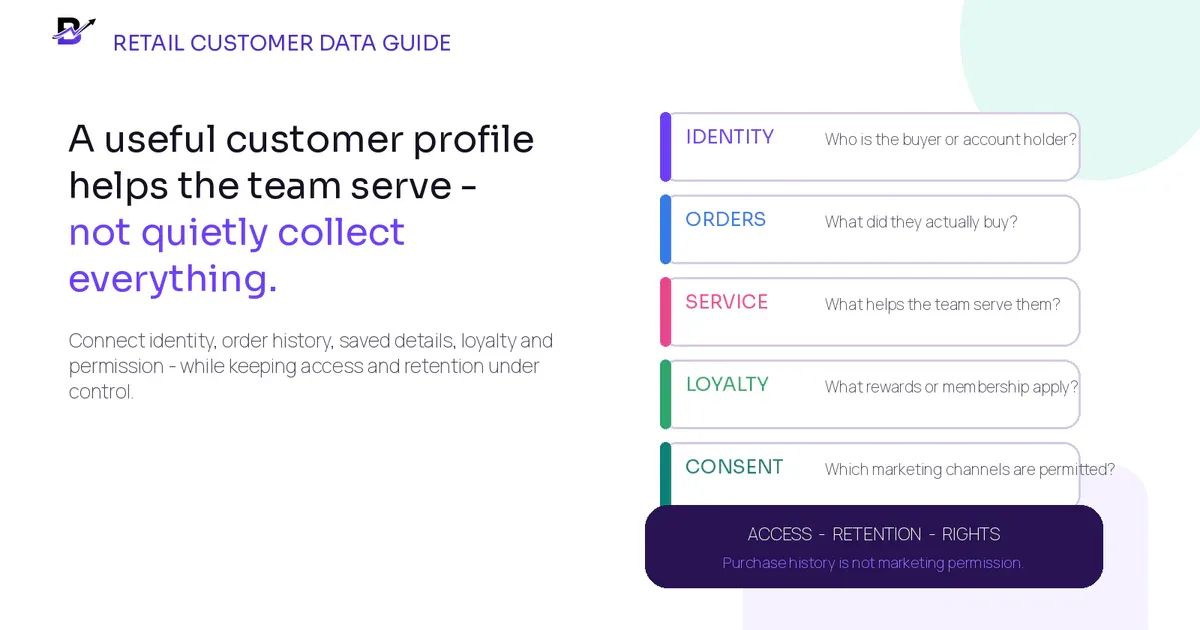
A useful customer profile helps the team serve without turning every order or recipient into a marketing audience.
A returning customer should not need to enter the same address, explain the same preference or search through old messages every time they buy. At the same time, a retailer should not treat every order, recipient phone number or loyalty enrolment as permission to send promotions.
The useful middle ground is a clean customer profile: one reliable identity, a traceable order history, service information the customer has actually provided, separate loyalty activity and a clear record of marketing choices. That profile helps the team serve people better without turning the customer database into an uncontrolled collection of notes and assumptions.
DIRECT ANSWER. Build a retail customer profile around five layers: identity, orders, service, loyalty and consent. Keep the buyer, sender and recipient separate where they are different people. Match profiles using reliable identifiers, review duplicate merges before confirming them, and never infer marketing permission from purchase history. Limit staff access, record how consent or opt-out was captured, and set a review or retention rule for every data group.
This guide is for retailers that sell through ecommerce, customer apps, POS, assisted orders or local delivery. It explains an operational method in easy English. Privacy, direct-marketing, retention and customer-rights requirements vary by market, so the business should confirm local obligations with a qualified adviser.
IMPORTANT. This article is practical operations guidance, not legal advice. Do not use it to decide a legal basis, statutory retention period or marketing rule without current local review.
In this guide
What a useful retail customer profile should contain
Why customer, buyer, sender and recipient are not always the same person
How to match customer identities across website, app, POS and assisted orders
How to review duplicates and merge profiles without losing important context
Why order history, loyalty membership and marketing permission must remain separate
How to use saved addresses and repeat-order data without making assumptions
Which staff roles should see which customer information
How to plan correction, export, retention and deletion processes
How Bloomlytix can support a connected customer journey within confirmed product scope
A customer profile should help service - not collect everything
A customer profile is useful when it helps the business answer real questions: Who placed this order? Which contact detail is current? Which address did the customer choose? What did they buy before? Are they a loyalty member? Which messages are operational, and which marketing channels are permitted?
The profile becomes risky when the team adds information simply because it is available. Long free-text notes, private conversations, recipient details, payment screenshots and personal assumptions can spread across staff accounts without a clear purpose. More data is not automatically better data.
PRACTICAL RULE. For every field, ask four questions: Why do we need it? Who should see it? How will it be corrected? When will it be reviewed, anonymised or removed?
The five layers of a useful retail customer profile
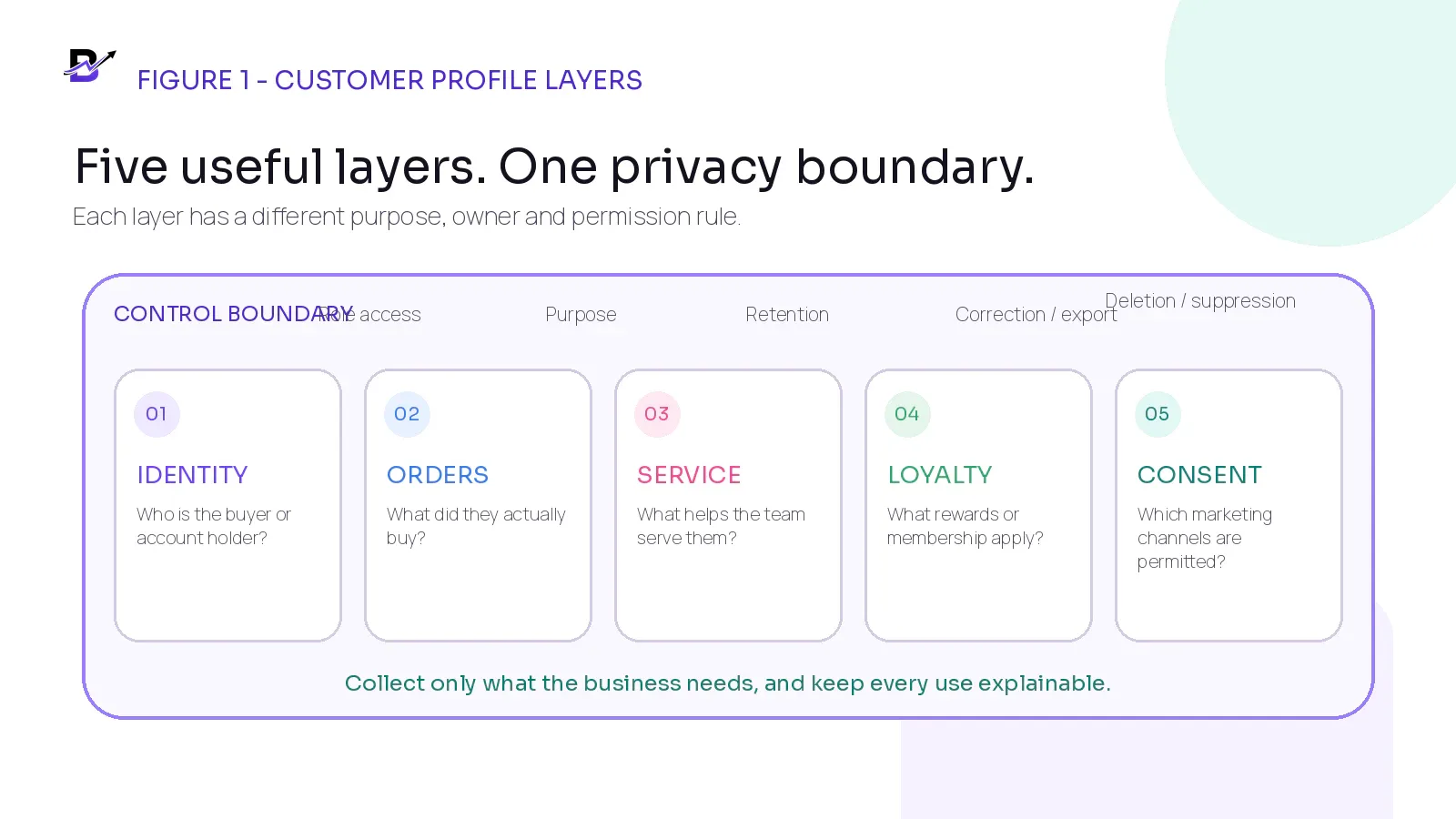
Figure 1. Identity, orders, service, loyalty and consent serve different purposes and need different controls.
LAYER | WHAT IT MAY CONTAIN | OPERATIONAL PURPOSE |
|---|---|---|
Identity | Name, customer ID, verified email or phone, account status and preferred language where provided. | Recognise the person and connect approved activity. |
Orders | Products, channels, branches, payment state, refunds, returns, delivery and order timeline. | Support customer service, repeat ordering and operational reporting. |
Service | Saved addresses, customer-provided preferences, support history and factual issue notes. | Reduce repeated questions and resolve problems consistently. |
Loyalty | Membership status, rewards, redemptions, tier or cashback activity where configured. | Apply the program rules without confusing membership with marketing permission. |
Consent | Channel-specific marketing status, evidence, statement version, time and withdrawal. | Control promotional communication and demonstrate the recorded choice. |
These layers can appear on one screen, but they should not become one uncontrolled field. Order history should not automatically change consent. A staff note should not change loyalty. A delivery recipient should not automatically become a marketing contact.
Separate the customer, buyer, sender and recipient
Specialty retail often involves more than one person. A customer can buy a gift for someone else. A company employee can place an order for a manager. A florist can receive the buyer details, sender name and recipient phone number in one order. Treating every person as the same customer creates privacy, service and reporting problems.
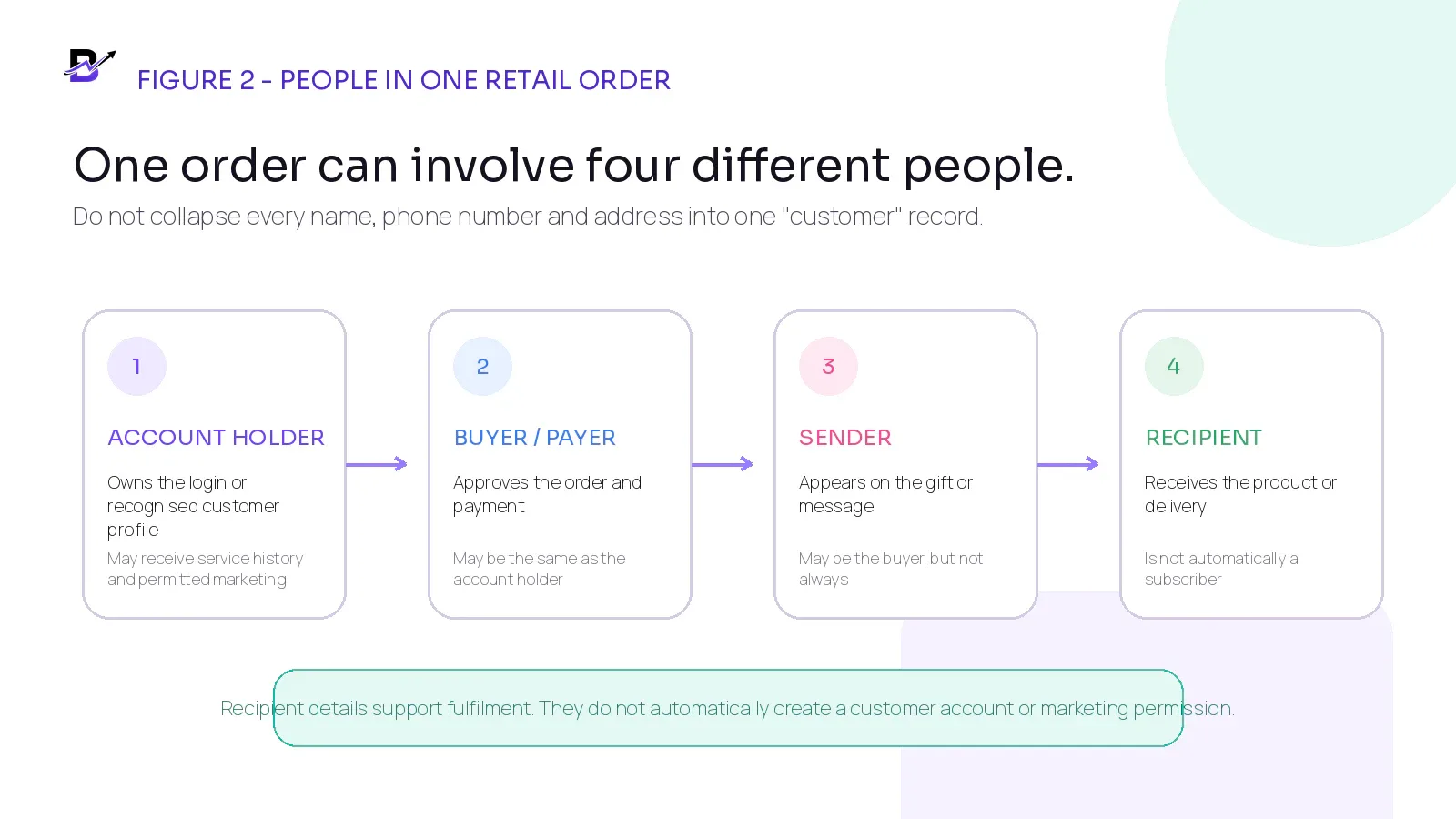
Figure 2. One order can involve several people, and each person has a different relationship with the retailer.
ROLE | WHAT IT MEANS | MAIN CONTROL |
|---|---|---|
Customer / account holder | Owns or uses the customer account and may have order history, addresses, loyalty and preferences. | Do not assume every buyer wants an account. |
Buyer / payer | Approves the product, price and payment. | May be a company representative or another person paying on behalf of the sender. |
Sender | Name or identity presented with a gift or message. | Can differ from the account holder and payer. |
Recipient | Receives the product or delivery and may need operational contact. | Do not automatically add the recipient to marketing, loyalty or the buyer profile. |
Corporate contact | Authorised buyer or coordinator for a business order. | Keep recipient lists and employee data under the approved corporate workflow. |
RECIPIENT RULE. A phone number supplied to complete a delivery is not automatically a customer account, loyalty enrolment or marketing subscription. Use it for the approved operational purpose and follow the correct local process before any additional use.
Choose useful fields and avoid risky notes
A profile needs enough information to support the customer journey, but not every detail that staff could possibly collect. Structured fields are easier to review, correct and restrict than a large notes box.
FIELD | USEFUL INFORMATION | GUARDRAIL |
|---|---|---|
Customer ID | Stable internal identifier | Do not use a name as the only match key. |
Name | Customer-provided display or legal name where needed | Avoid titles or assumptions the customer did not provide. |
Email / phone | Verified or customer-provided contact details | Keep the country code and status; do not copy contact details from recipients without purpose. |
Addresses | Saved billing, pickup or delivery addresses where the customer chooses to retain them | Ask the customer to confirm the address for each important order. |
Order history | Orders, products, channels, dates, status, refunds and delivery outcomes | Keep the factual transaction history; separate it from marketing permission. |
Preferences | Language, product or service preference the customer actively provided | Do not infer sensitive personal traits from purchases or messages. |
Service notes | Short factual context needed to resolve an issue or maintain a promise | Avoid opinions, blame, private family details or unrelated personal information. |
Consent / opt-out | Channel, status, source, time, wording version and withdrawal | Do not replace evidence with a single unchecked “yes” field. |
NEVER STORE IN A GENERAL NOTE. Full payment-card numbers, passwords, government identity documents, unrelated health information, private relationship details, discriminatory labels or subjective comments about a customer should not be placed in a normal retail profile.
European data-protection guidance describes data minimisation as collecting information that is adequate, relevant and limited to what is necessary for the stated purpose. It also recommends retention review rather than keeping personal data indefinitely.
Official reference: European Commission - principles of personal data processing
Create one reliable customer identity across channels
A retailer may recognise the same person through a website login, customer app, POS sale, phone order, WhatsApp conversation or support request. The goal is not to force every event into a profile. The goal is to connect records when the identity evidence is reliable and keep them separate when it is not.
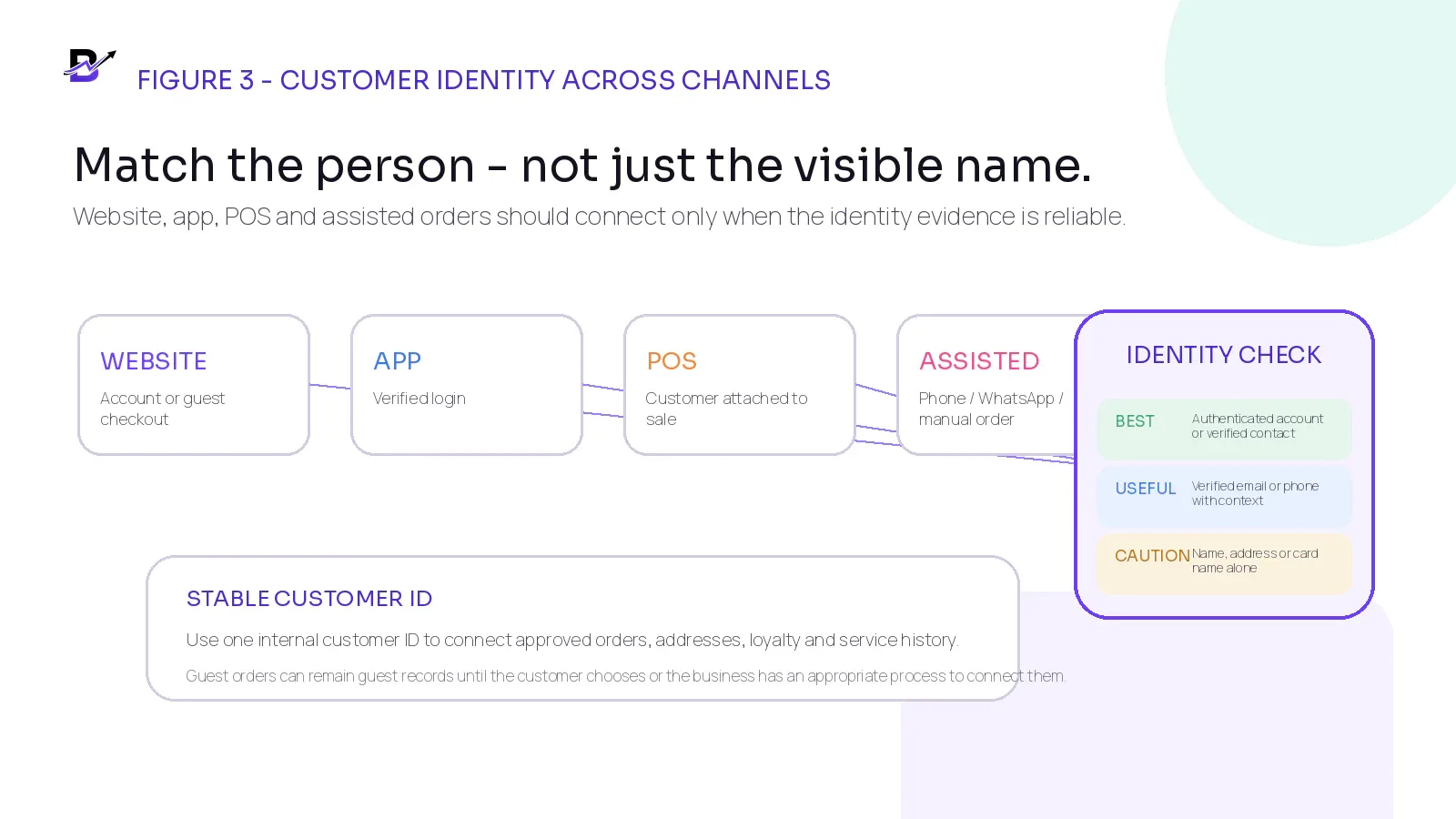
Figure 3. Use stable customer IDs and verified contact details instead of matching people by name alone.
IDENTITY SIGNAL | RELIABILITY | OPERATING RULE |
|---|---|---|
Authenticated account | Strong | The person signs into the recognised account or completes a verified account process. |
Verified email or phone | Strong when current and contextual | Match only under the documented rule and keep the source visible. |
POS customer selected by staff | Useful with confirmation | Ask staff to confirm the customer rather than choosing the first similar name. |
Guest checkout | Separate unless appropriately connected | Do not create a permanent profile merely because an order has an email address. |
Name only | Weak | Different people can share a name; spelling and formatting also change. |
Address or payment-card name | Weak or unsuitable alone | A household, company, receptionist or gift recipient can share the same detail. |
Normalise the format before searching for duplicates. Store phone numbers with the correct country context, remove obvious spacing differences from comparison values, validate email input and keep the original verified contact for display. Use a stable internal customer ID even when the customer changes an email address or phone number.
GUEST ORDER RULE. A guest order can remain a guest order. Connect it to a customer profile only through the approved account, identity and privacy process - not through an invisible guess.
Merge duplicate profiles carefully
Duplicate profiles can split order history, loyalty balances, addresses and service notes. They also make reporting unreliable. However, merging the wrong two people can be more damaging than leaving a duplicate for review.
Find duplicate candidates using reliable identifiers and account context. Treat similar names as a clue, not proof.
Compare contact details, addresses, recent orders, branch activity, account status and the source of each record.
Review marketing status by channel. Do not silently turn an unknown, declined or withdrawn status into subscribed.
Choose the surviving name, contact details and saved addresses deliberately. Preserve the transaction and audit history.
Record who approved the merge, when it happened and which original IDs were combined.
Test the result: account access, order history, loyalty, returns, service notes and reporting should still work as intended.
MERGE WARNING. A merge may be difficult or impossible to reverse. Require an authorised role and a visible preview before completing it.
Current ecommerce platforms provide merge tools, but the exact behaviour and limitations differ. Shopify, for example, tells merchants to review which contact details remain and notes that some merge operations cannot be undone.
Operational reference: Shopify - managing and merging customer profiles
Connect online, app, POS and assisted orders to the same customer where appropriate
A connected customer view should follow the customer across channels without creating a separate identity for each one. The website and customer app may use an account. POS staff may attach a known customer to a walk-in sale. A manual or WhatsApp-assisted order may begin as a conversation and later connect to the account holder after confirmation.
CHANNEL | HOW IDENTITY APPEARS | CONTROL |
|---|---|---|
Website | Account login or guest checkout | Use the account when authenticated; keep guest activity separate unless the approved rule connects it. |
Customer app | Authenticated profile, saved addresses and order history | Use the same customer identity as the website rather than creating an app-only profile. |
POS | Staff searches or creates a customer during the sale | Require confirmation before attaching the sale; do not select a similar name casually. |
Phone / WhatsApp | Staff captures the confirmed buyer and order | Move the order into the official workflow; do not copy the full private conversation into the profile. |
Corporate order | Authorised buyer plus separate recipients | Keep the buyer or company relationship separate from recipient records and delivery lists. |
One shared customer record is valuable only when the business can explain why the records belong together. Reliable matching is more important than achieving a high percentage of “known customers.”
Keep service messages separate from marketing
Order confirmations, payment updates, pickup reminders, delivery status and refund information support an existing transaction. Promotions, discounts, new-product announcements and win-back messages try to encourage another purchase. Those purposes should be visible separately in the system.
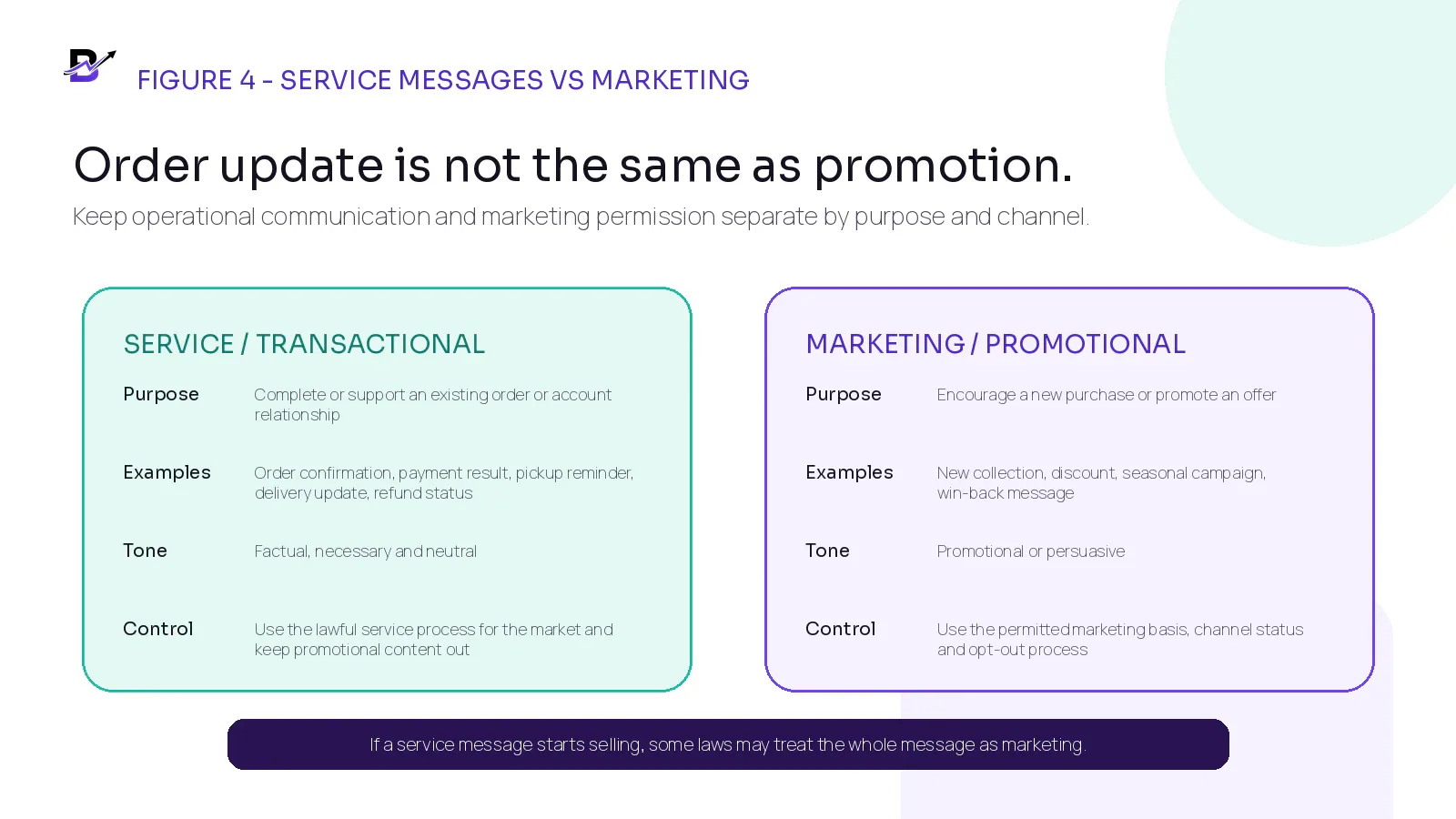
Figure 4. Service communication and marketing can use the same contact detail but require different purpose and permission controls.
MESSAGE | LIKELY PURPOSE | OPERATING NOTE |
|---|---|---|
Order confirmation | Service / transactional | Confirm the order number, product, amount, delivery or pickup promise. |
Payment failed | Service / transactional | Explain the failed payment and the action needed to complete the existing order. |
Out for delivery | Service / transactional | Give a factual status update tied to the current order. |
New collection | Marketing | Promotes products beyond the existing transaction. |
Seasonal discount | Marketing | Encourages another purchase. |
Loyalty balance statement | Depends on content and market | A neutral account update may be service; an attached promotion can change the classification. |
CONSERVATIVE RULE. Keep operational messages factual and necessary. Send promotional content only through the permitted marketing process for the relevant country, channel and customer status.
Official regulator guidance distinguishes neutral service messages from communications that promote products or offers. A service message can become direct marketing when promotional content is added.
Official reference: UK Information Commissioner - identifying direct marketing and service messages
Record consent and opt-out evidence by channel
A single “marketing: yes” value is not enough for a serious customer-data process. The business may use email, SMS, WhatsApp, app push notifications or other channels, and each one can have different rules and customer choices.
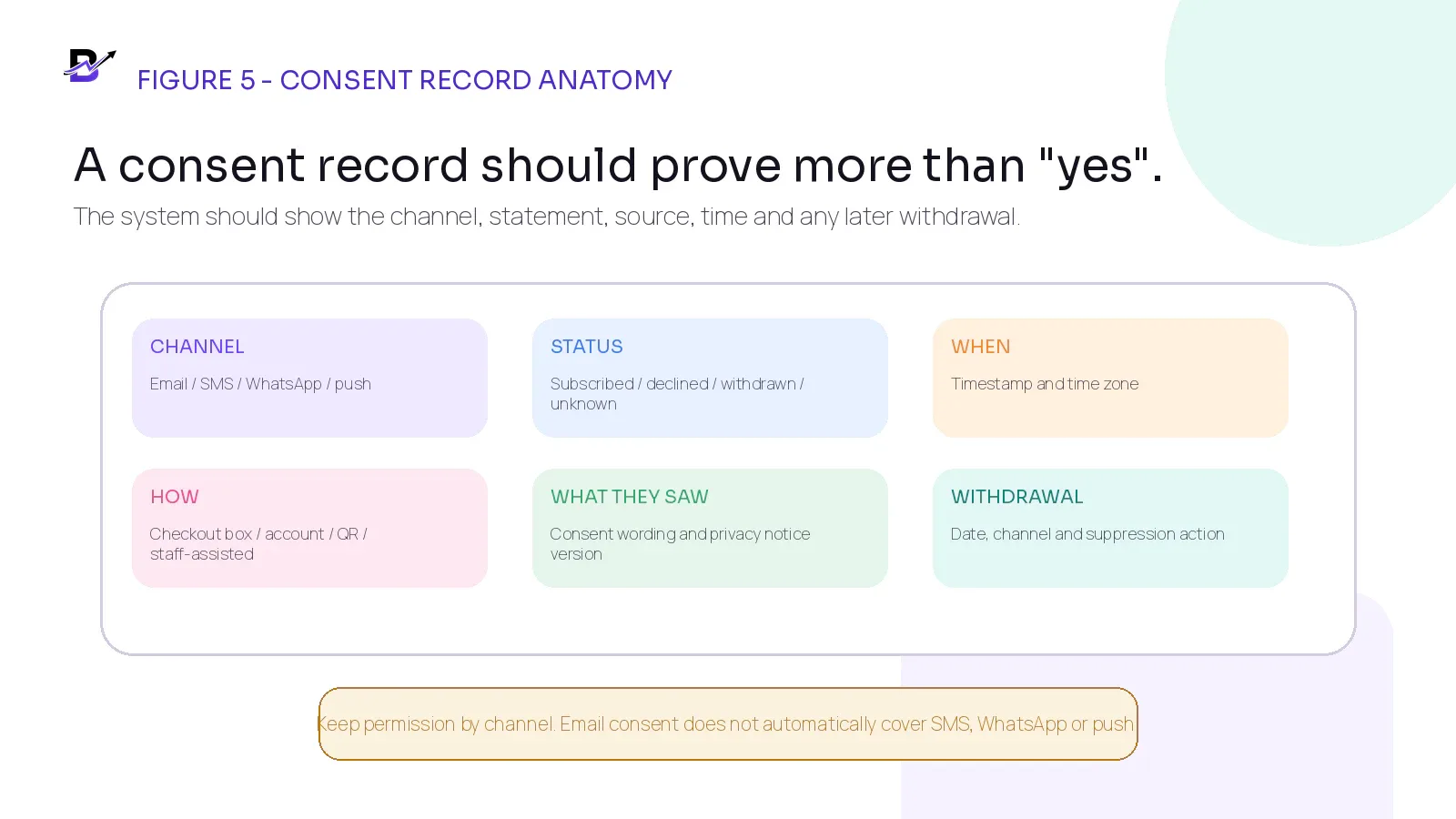
Figure 5. A useful permission record shows what the customer agreed to, how it was captured and whether it was later withdrawn.
CONSENT FIELD | WHAT TO RECORD |
|---|---|
Channel | Email, SMS, WhatsApp, push or another configured channel. |
Status | Subscribed, declined, withdrawn, pending, unknown or technically suppressed. |
Timestamp | When the choice was made, including time zone where useful. |
Source | Checkout, account, QR code, loyalty sign-up, staff-assisted form or import. |
Statement version | The exact or versioned wording and privacy notice shown at the time. |
Method / evidence | Checkbox, account action, recorded verbal process or another approved method. |
Withdrawal | When and how the customer opted out, plus the suppression action taken. |
Market / context | The store, country, brand or campaign context when it affects the rule. |
Where a business relies on consent, official guidance commonly expects it to be specific, informed, freely given and based on a clear affirmative action. It should also be possible to show who consented, when, how, what they were told and whether they later withdrew.
Official references: ICO - obtaining, recording and managing consent · European Data Protection Board - data protection basics
Order history, loyalty and marketing permission are separate
A customer can have an order history without joining loyalty. A customer can join loyalty without agreeing to every marketing channel. A customer can unsubscribe from promotions while the business still needs to send a necessary delivery update or keep transaction records required for accounting, warranty, fraud prevention or disputes.
RECORD | PURPOSE | SEPARATION RULE |
|---|---|---|
Order history | What happened in completed or attempted transactions | Do not use it as automatic proof of promotional permission. |
Customer account | Login, profile, addresses and self-service tools | Account creation does not automatically permit every marketing channel. |
Loyalty membership | Rewards, cashback, points, tier and redemption activity | Membership and marketing choices should be visible separately. |
Marketing consent / status | Permission or other approved rule for promotional communication | Store by channel and respect withdrawal or suppression. |
Service communication | Necessary information about an existing order or relationship | Keep it factual and avoid turning it into a promotion. |
CORE PRINCIPLE. Purchase history can support service and analysis. It is not, by itself, marketing permission.
Use saved details and order history without becoming intrusive
Order history can make repeat purchasing easier. It can help customer service find the right order, let a customer reorder a product, show a saved address or remind staff about a customer-provided preference. The same history becomes intrusive when the business treats old information as a permanent fact or makes personal assumptions.
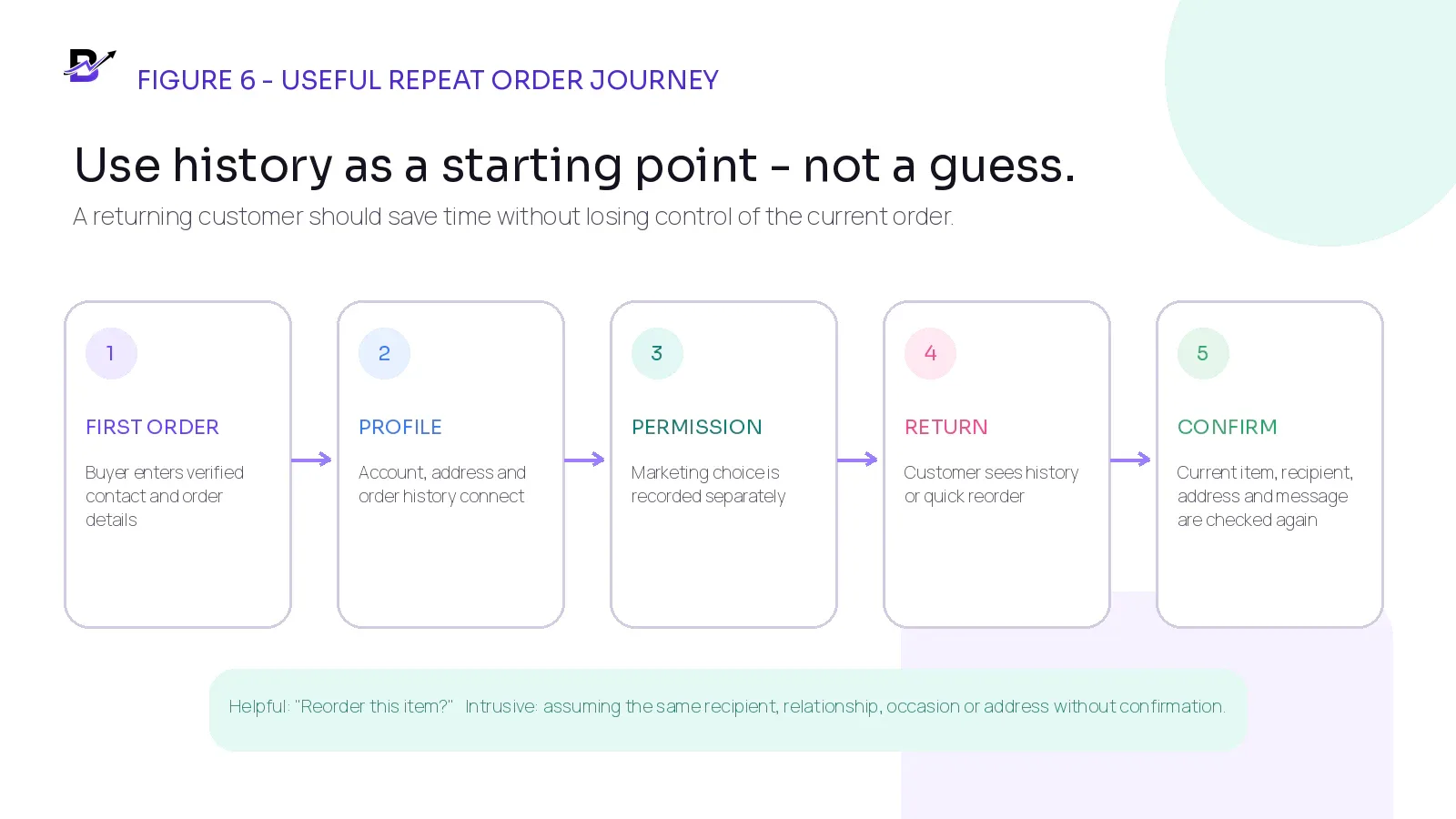
Figure 6. Use history to reduce repeated entry, then confirm the current product, recipient, address, message and permission.
USE | EXAMPLE | CONTROL |
|---|---|---|
Helpful | Offer the previous item as a reorder starting point. | Confirm current price, availability, options and delivery. |
Helpful | Show a saved address chosen by the customer. | Ask the customer to confirm it is still correct. |
Helpful | Remember a language or service preference the customer provided. | Allow correction and do not infer unrelated traits. |
Risky | Assume the same recipient, relationship or occasion from a past gift order. | A gift history can include private or outdated context. |
Risky | Contact a past recipient because their phone number appears in delivery history. | The recipient may never have created an account or marketing relationship. |
Risky | Use free-text notes to label a customer subjectively. | Keep notes factual, necessary and reviewable. |
Give each staff role only the customer data it needs
Customer data should follow the same responsibility-first access model used for orders, cash and stock. A driver may need the recipient and delivery note for an assigned order. A marketing user may need the permitted subscriber segment. Neither role needs unrestricted access to every customer note, refund or address.
ROLE | USEFUL ACCESS | RESTRICTION |
|---|---|---|
Owner / authorised admin | Wider profile, policy settings, reports, exports and access review. | Use only for authorised governance and support. |
Customer service | Contact details, order history, delivery context and factual service notes. | Hide unrelated operational settings and sensitive exports. |
POS staff | Customer lookup, selected order history and allowed profile edits. | Limit merging, exporting and marketing-status changes. |
Fulfilment staff | Order-specific customer or recipient context needed to prepare the item. | Do not expose the full customer database. |
Driver | Assigned recipient, address, permitted contact and proof actions. | Restrict access to assigned deliveries and the required time window. |
Marketing team | Permitted segments, channel status and campaign results. | Do not expose free-text service notes or recipient data by default. |
External support | Minimum access required for the approved support task. | Use controlled, time-limited and logged access where available. |
Review activity logs, exports, merge actions and changes to marketing status. A permission design is not complete until the business can see who used the access and remove it when the role changes.
Plan correction, export, retention and deletion before a request arrives
A customer-data process should not begin only when someone asks for a copy or deletion. Define the steps, owners and limits in advance. Transaction records, tax documents, fraud-prevention data, chargebacks, warranties and legal claims can have different retention needs from saved addresses, support notes or marketing preferences.
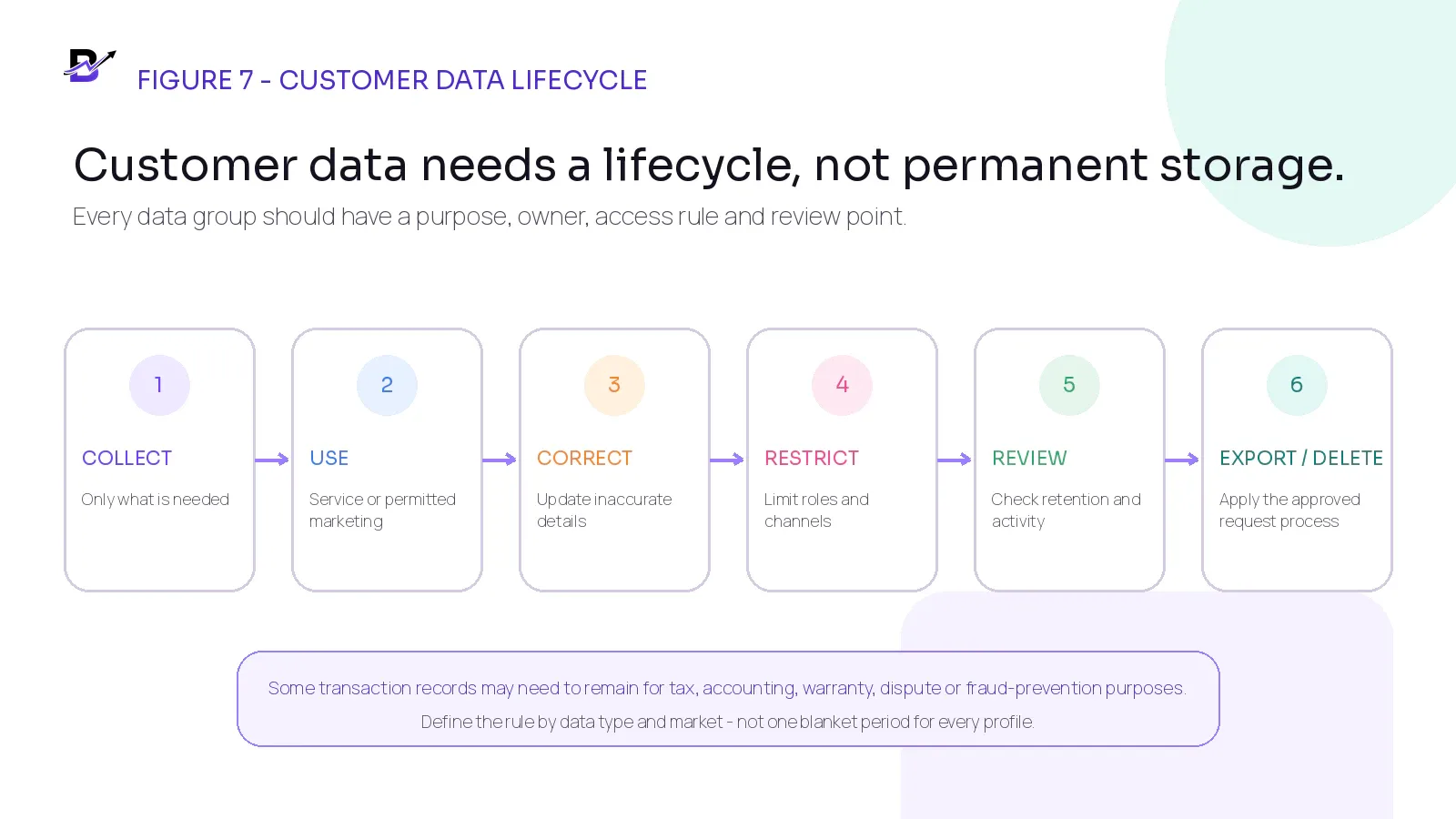
Figure 7. Every data group needs a lifecycle and a named owner.
IMPLEMENTATION AREA | QUESTION TO ANSWER |
|---|---|
Correction | How can a customer or authorised staff member update an inaccurate name, email, phone or address? |
Access / export | Which data can be exported, in what format, by whom, and how is identity verified? |
Deletion / erasure | Which profile fields can be removed, anonymised or suppressed, and which records must remain? |
Retention | Which purpose or legal obligation determines the review period for each data group? |
Inactive accounts | When is an inactive profile reviewed, anonymised or removed? |
Opt-out suppression | How will the business remember not to send marketing after a profile or campaign record changes? |
Third parties | Which payment, messaging, loyalty or integration providers also hold customer information? |
Incident response | Who investigates inappropriate access, export, disclosure or data loss? |
Shopify distinguishes deleting a customer profile from erasing personal data and notes that some order information can remain after personal information is redacted. This illustrates why retailers need a defined process rather than a single “delete” button assumption.
Operational reference: Shopify - processing customer data requests
Worked example: one repeat gifting customer
Nadia places a gift order through the website. She pays for a box, adds chocolates and a greeting message, and enters Sarah as the recipient. Nadia chooses to create an account and agrees to email offers, but does not choose SMS marketing.
MOMENT | WHAT THE PROFILE SHOULD DO | CONTROL |
|---|---|---|
First checkout | Nadia becomes the account holder and buyer. Sarah remains the delivery recipient for that order. | Do not add Sarah to Nadia's account as a marketing contact. |
Order history | The product, add-ons, payment, message, delivery and outcome remain on Nadia's order history. | Customer service can answer a later question from one record. |
Consent | Email marketing is subscribed with source, time and wording version. SMS remains declined or unknown according to the actual choice. | Do not copy the email choice to other channels. |
Saved address | Nadia chooses whether to save the delivery address. | A saved address is a convenience, not proof that the same recipient or address applies forever. |
Second purchase | Nadia signs into the app, opens order history and starts a reorder. | The system should ask her to confirm product, recipient, address, message and delivery timing. |
Customer service | A permitted staff member sees Nadia's profile, orders and service context. | The staff member should not see unrelated private notes or unrestricted exports. |
WHAT GOOD PERSONALISATION LOOKS LIKE. The system removes repeated work but gives the customer control over the current order. It remembers the account and history; it does not assume the same recipient, occasion or permission.
Use a Customer Data and Consent Map
Before configuring a customer database, map each data group from collection to retention. The map below can be copied into an implementation sheet and completed with the product, privacy, customer-service and marketing owners.
DATA GROUP | SOURCE | PURPOSE | ACCESS | MARKETING USE | REVIEW / RETENTION |
|---|---|---|---|---|---|
Customer ID + login | Website / app / POS | Account access and identity | Owner, customer service | No direct marketing use | Review on account change or closure |
Email / phone | Checkout, account, POS, assisted order | Service communication and identity | Customer service; marketing only if permitted | Separate status by channel | Correct on request; review invalid contacts |
Saved address | Customer account | Faster checkout or delivery | Customer and permitted service roles | No automatic marketing use | Confirm at each important order; remove when no longer needed |
Order history | All sales channels | Service, returns, reporting and repeat order | Service, owner, permitted staff | Segmentation only under approved rules | Retain according to transaction and legal requirements |
Recipient details | Delivery order | Complete the specific handoff | Service, fulfilment, assigned driver | Do not add to marketing by default | Review after operational and legal need ends |
Loyalty activity | Loyalty enrolment / purchase | Rewards and member service | Customer service, owner, loyalty team | Separate from marketing status | Review under program terms and inactivity policy |
Marketing status | Checkout, account, QR, form, staff-assisted | Control promotional messages | Marketing admin and authorised service | Yes, only for the recorded channel and status | Keep withdrawal / suppression evidence |
Service notes | Customer service | Resolve issues and preserve factual promises | Permitted service and manager roles | No | Review stale or unnecessary notes regularly |
PRACTICAL ASSET. Use this map as the starting point for implementation. Add the exact system field, owner, lawful basis or approved rule, export method and retention period after qualified review.
Metrics that reveal profile quality
Do not measure success only by the number of customer records. A database can grow while becoming less useful. Start with metrics that expose identity, consent and service problems.
METRIC | SIMPLE DEFINITION | WHAT IT CAN REVEAL |
|---|---|---|
Duplicate profile rate | Likely duplicate profiles divided by active profiles. | Whether channel or staff processes are creating split identities. |
Known-order match rate | Orders correctly attached to a verified or approved customer profile. | Whether connected history is useful without forcing guest orders into profiles. |
Consent evidence completeness | Subscribed records with channel, source, time and wording/version evidence. | Whether permission can be explained later. |
Unknown marketing status | Profiles where the status cannot be demonstrated. | Whether imports or legacy data need review before campaigns. |
Address correction rate | Orders requiring address correction after confirmation. | Whether saved or copied addresses are creating delivery risk. |
Profile merge exceptions | Merges blocked, reversed or found incorrect. | Whether identity rules or staff permissions need improvement. |
Service-note age | Notes not reviewed after the defined period. | Whether free-text information is becoming stale or unnecessary. |
Opt-out processing time | Time from withdrawal request to suppression across relevant tools. | Whether customer choices flow through the complete marketing stack. |
Avoid universal targets copied from another business. Establish a baseline, define the quality rule and investigate the cause behind each exception.
How Bloomlytix can support the connected customer journey
Bloomlytix brings ecommerce, customer apps, POS, fulfilment, payments, delivery and reporting into one operating platform. Its current platform overview lists customer accounts, saved addresses, order history, quick reorder, walk-in customers, recipient details and role-based access. The exact customer-matching, duplicate-merge, consent-evidence, export and retention workflow should be confirmed during discovery.
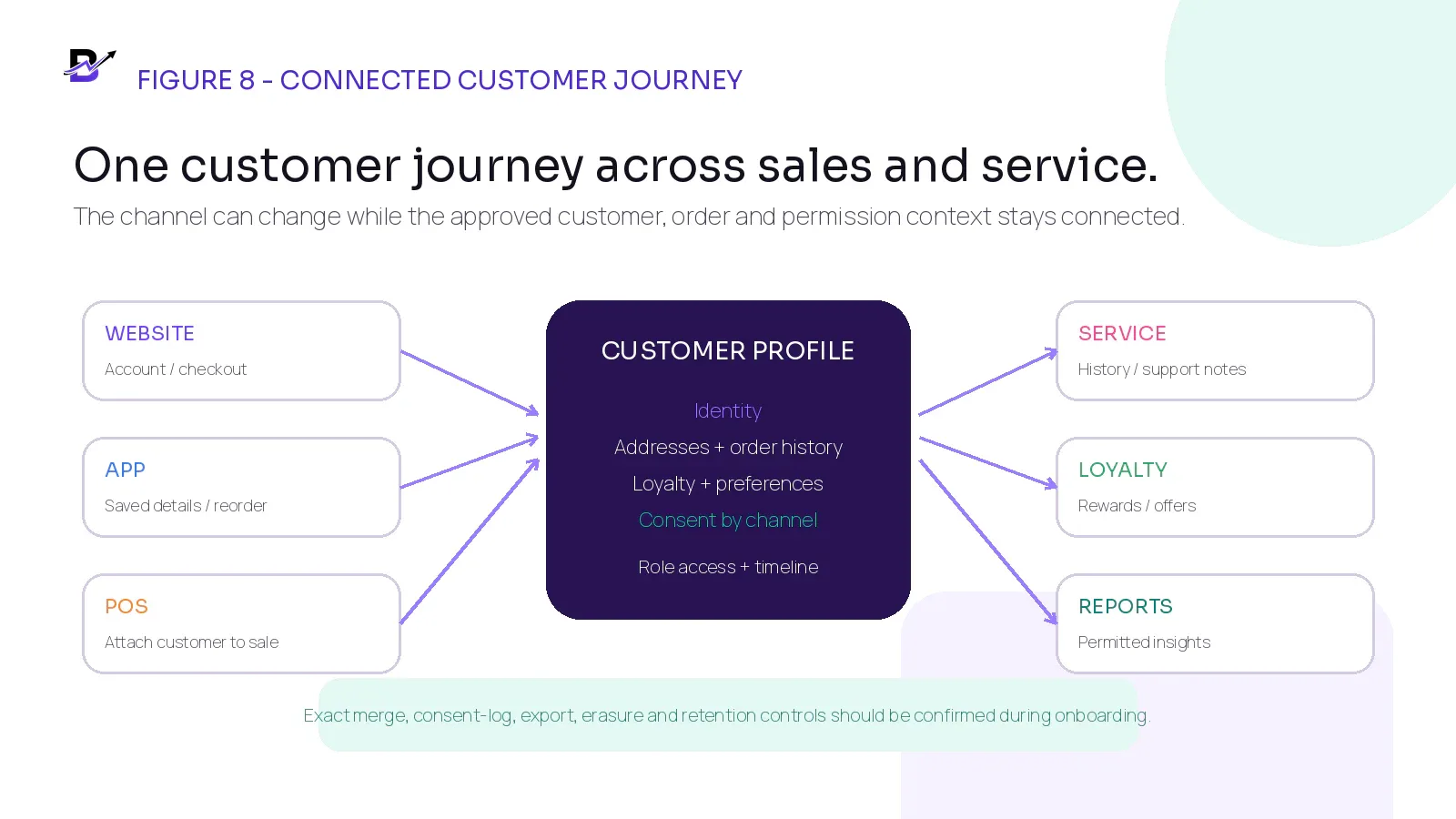
Figure 8. A connected platform can keep customer and order context together while permissions and role access remain explicit.
BLOOMLYTIX AREA | POSSIBLE ROLE |
|---|---|
Customer accounts | Login, profile, saved addresses, order history, wishlist and quick reorder in configured customer channels. |
Shared sales context | Website, app, POS and assisted orders can use the same wider business records rather than separate customer silos. |
Service history | Permitted staff can use order history, addresses and factual customer-service notes where configured. |
Loyalty and offers | Rewards, cashback, coupons, offers and notifications can support repeat journeys under the configured program and permissions. |
Role-based access | Owners, managers, shop staff, drivers and support roles can receive different access according to the business setup. |
Reporting | Customer repeat purchase, app engagement, campaign and sales insights can be available where configured. |
PRODUCT SCOPE. Confirm the exact customer-matching, duplicate-merge, consent-log, suppression, data-export, erasure, retention-automation, cookie-consent and marketing-integration workflow during discovery. Bloomlytix does not provide a blanket legal-compliance guarantee.
Bloomlytix's current privacy policy explains that a business customer generally controls why its customer and recipient data is processed, while Bloomlytix processes that tenant data to provide the contracted service. The business remains responsible for its notices, permissions and lawful use.
Bloomlytix references: Privacy policy · Website vs mobile app guide · Retail loyalty program guide
Questions to ask during a customer-profile demonstration
How does the system create or identify a customer from website, app, POS and assisted orders?
Can guest orders remain separate until the business has an approved reason to connect them?
Which fields are used to find duplicate profiles, and does an authorised user review the merge first?
What happens to orders, addresses, loyalty activity and marketing status after a merge?
Can buyer, sender, recipient and corporate-contact details stay separate on the same order?
Can customers update their own name, email, phone or saved addresses where appropriate?
Are service messages and marketing status separated by purpose and channel?
Can the system record the consent source, timestamp, statement version and withdrawal?
Can staff access be limited by role, branch, assigned order and task?
How are customer access, correction, export, erasure and suppression requests handled?
Can the business export customer, order and consent information in a usable format?
Which customer-data, cookie, marketing, loyalty or privacy controls are standard, configurable, integrated or separately scoped?
Frequently asked questions
What information should a retail customer profile contain?
Only the information needed for the defined service and permitted marketing purposes. A practical profile may include identity, verified contact details, saved addresses, order history, customer-provided preferences, loyalty activity, factual support notes and separate channel-specific marketing status.
Is order history the same as marketing consent?
No. Order history records transactions and service activity. Marketing consent or another permitted marketing rule must be handled separately according to the applicable market and channel.
How should duplicate customer profiles be merged?
Use reliable identifiers, review conflicting contact details, orders, addresses, loyalty and consent before confirming, preserve an audit trail and limit merge permission to authorised roles.
Can recipients be added to marketing lists?
Not automatically. A recipient detail supplied to complete a delivery has a different purpose from a marketing subscription. Follow the correct local notice and permission process before any additional use.
Does loyalty membership automatically permit marketing?
Not necessarily. Loyalty membership, operational membership messages and promotional marketing should have separate visible rules and channel statuses.
Who should be allowed to view customer data?
Only roles that need the information for their task. Customer service, POS, fulfilment, delivery, marketing and owners normally need different levels of access.
How long should customer data be kept?
There is no universal period. Set a rule by purpose, legal obligations, transaction records, disputes, warranties, inactive accounts, marketing suppression and the market where the business operates.
Can Bloomlytix merge profiles and manage consent automatically?
Bloomlytix supports connected customer accounts, order history, saved details, loyalty-ready journeys, staff roles and operational records. Confirm the exact duplicate-matching, merge, consent-evidence, export, deletion and retention workflow during discovery; these controls should not be assumed to be automatic.
Final profile-quality checklist
Every profile has a stable internal customer ID.
Customer, buyer, sender, recipient and corporate contacts are separated when necessary.
Email and phone formats are normalised without overwriting verified details blindly.
Duplicate matches use reliable evidence, not names alone.
Merge actions are previewed, authorised and logged.
Order history does not automatically change marketing status.
Loyalty membership and marketing permission are stored separately.
Marketing status is visible by channel, source, time and withdrawal.
Service notes are factual, necessary and regularly reviewed.
Recipient data is used only for the approved delivery or service purpose unless another valid process applies.
Staff access follows role, branch, assigned order and task.
Correction, export, deletion, suppression and incident procedures have named owners.
Each data group has a purpose and retention or review rule.
Third-party payment, messaging, loyalty and analytics tools are included in the data map.
The customer can repeat an order without the system assuming the same recipient, address, message or permission.