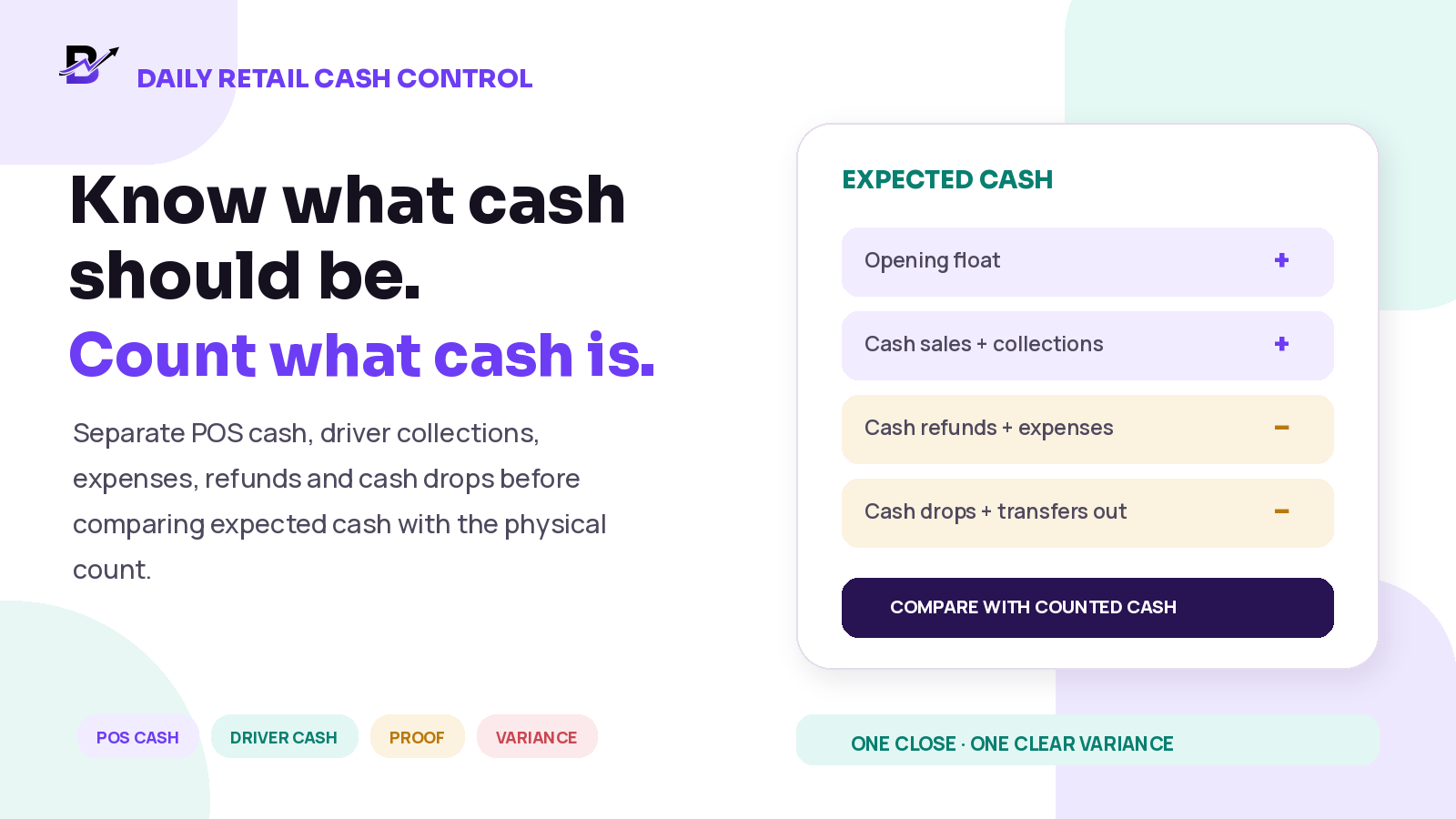
A sale can be recorded correctly while the cash is still with the cashier, driver, manager or bank bag. Daily closing should explain exactly where the money is.
A sale is not the same as cash in hand. A shop may complete cash and card sales at the counter, collect money through drivers, refund a customer, pay a small expense, move cash into a safe and leave a change float for tomorrow. Each event affects the daily close in a different way.
When records are spread across POS totals, chat messages, handwritten receipts and staff memory, the owner may know the day’s revenue but still not know how much physical cash should exist—or who currently holds it.
DIRECT ANSWER
Daily retail cash reconciliation compares the cash a specific holder should have with the cash physically counted. Start with opening float, add cash sales and additional collections now held by that person, subtract cash refunds, approved expenses, cash drops and transfers out, then compare with the count. Keep each difference visible with a reason, reviewer and follow-up; do not alter the original sale to make it disappear.
This guide is for florists, gifting brands, bakeries, cafés, perfume shops, jewellery retailers and other businesses that accept cash at a counter, through staff or during local delivery. It explains operational cash control, not tax, audit or statutory accounting advice.
Keep three different records separate
Most cash problems begin when three different questions are answered with one number. The business should know what it sold, how the customer paid and where the physical money is now.
RECORD | WHAT IT ANSWERS | WHY IT MATTERS |
|---|---|---|
Sales revenue | What the business sold during the period. | Useful for performance, but it does not prove where cash is. |
Payment status and method | Cash, card, gateway, bank transfer, payment link or another method; paid, pending, failed or refunded. | Shows how the order was settled and which report should be checked. |
Physical cash balance | Money held by a till, cashier, driver, branch, petty-cash box, safe or bank bag. | This is what can be counted and handed over. |
CORE PRINCIPLE
Revenue can be correct while cash custody is unclear. Reconcile the payment record and the physical cash holder—not only the sales total.
A card sale increases revenue and can create a paid order, but it does not increase the cash in the till. A cash-on-delivery order may be delivered while the money is still with the driver. A bank drop reduces the drawer balance even though it does not reduce revenue.
Use one simple expected-cash formula
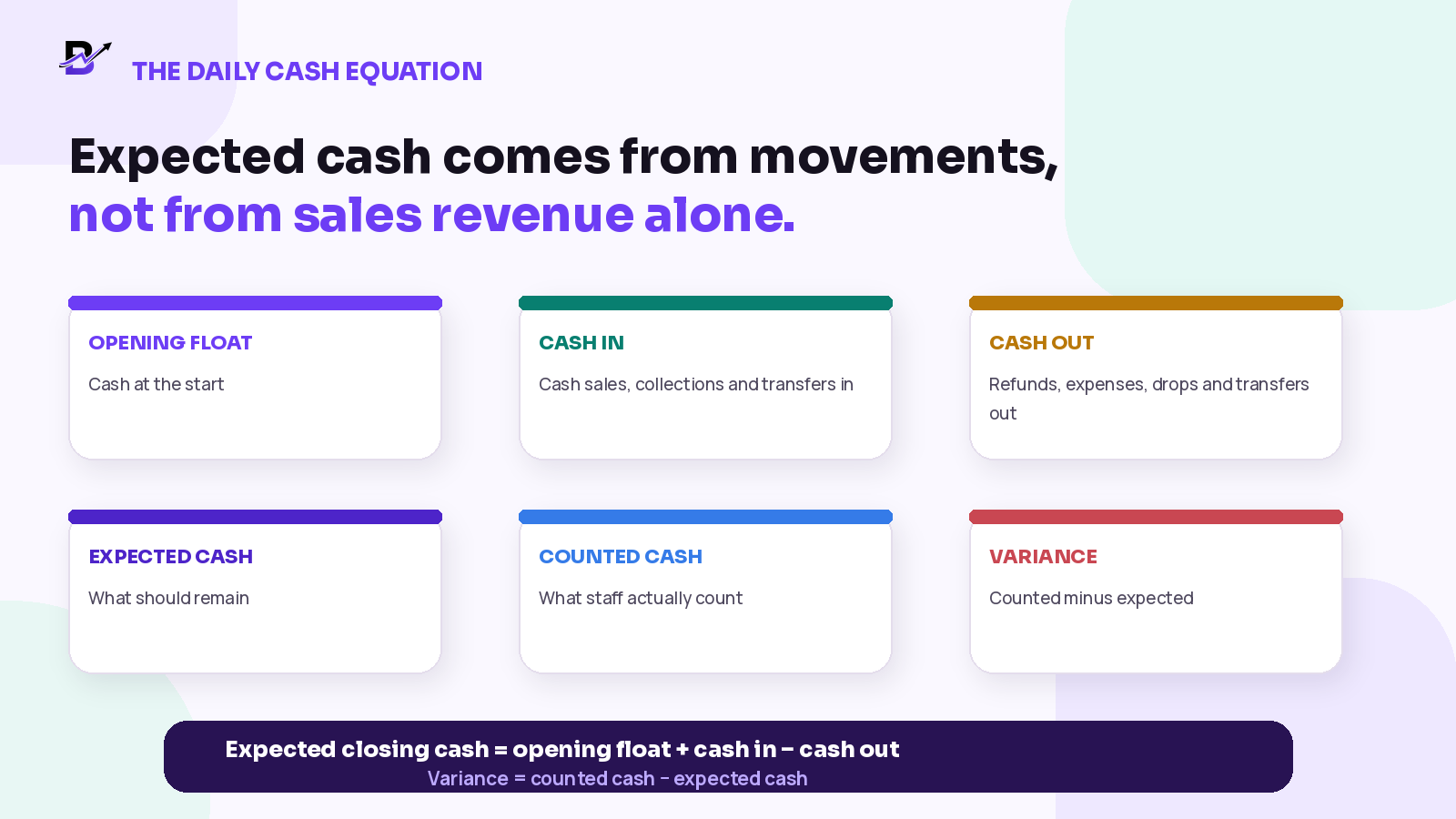
Figure 1. Expected cash is built from recorded cash movements. Counted cash is the physical amount. The difference is the variance.
WORKING FORMULA
Expected closing cash = opening float + cash sales + additional cash collections + transfers in − cash refunds − cash expenses − safe or bank drops − transfers out. Count collections only when that holder has received the cash, and exclude any amount already included in cash sales.
VARIANCE FORMULA
Cash variance = counted cash − expected cash. A negative result is short cash. A positive result is over cash.
Only cash movements belong in the physical cash equation. Card, wallet and online gateway transactions should be checked in their own payment and settlement reports. A refund changes the drawer only when the refund is paid in cash. If a cash-on-delivery order is also recorded as a POS cash sale, do not add its collection a second time.
Record the movements that change expected cash
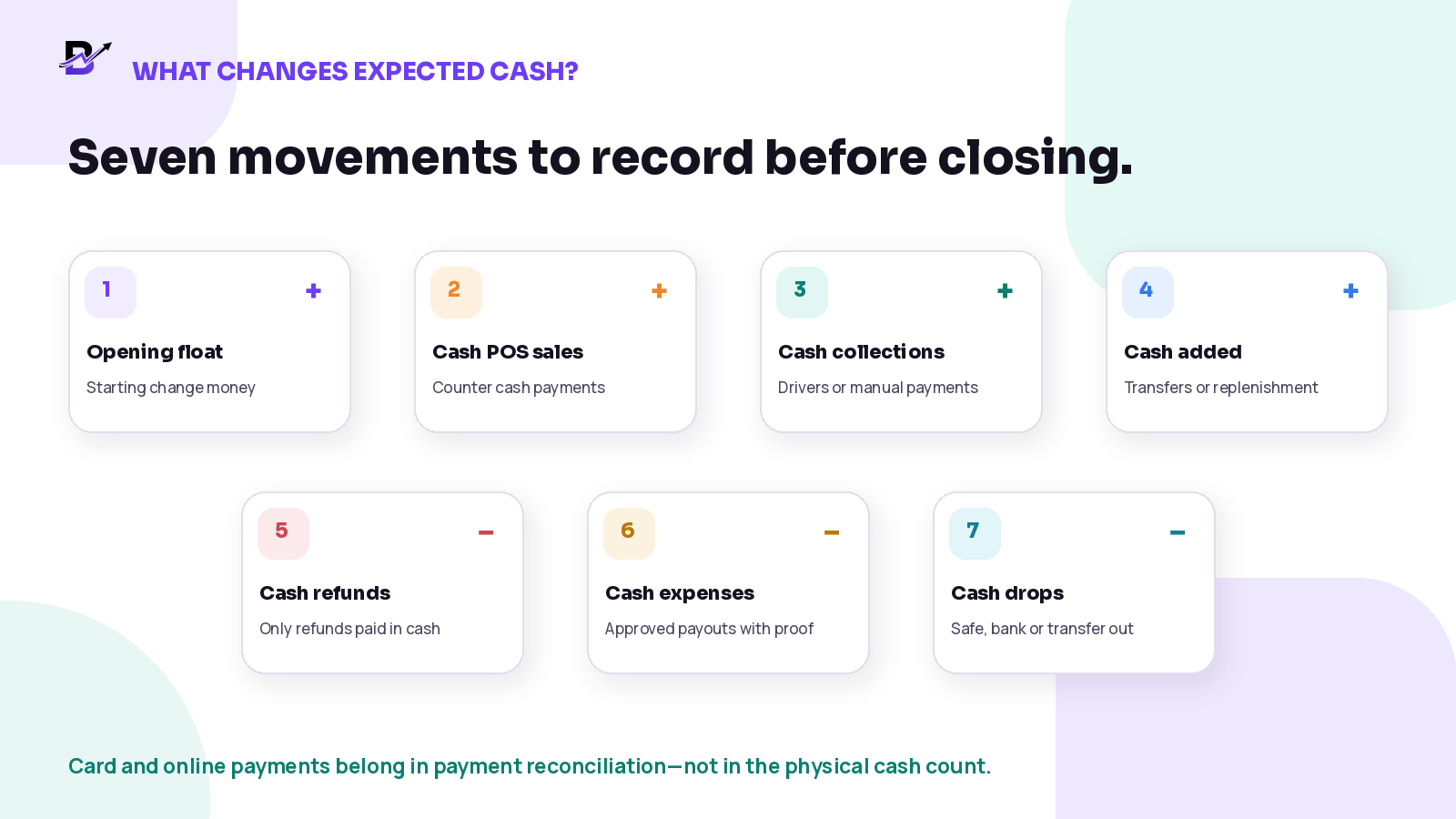
Figure 2. Every cash movement needs an amount, time, holder, reason and supporting reference where appropriate.
MOVEMENT | EXAMPLE | EFFECT | MINIMUM CONTROL |
|---|---|---|---|
Opening float | Cash left for change at the start. | Increase | Count and assign it to a named till or person. |
Cash POS sale | Customer pays cash at the counter. | Increase | Use the correct cash payment method on the sale. |
Cash collection | Driver or staff member receives cash for an order. | Increase | Link it to the order and the current holder; do not add it again if already in POS cash sales. |
Cash added / transfer in | Manager adds change or transfers cash in. | Increase | Record source, destination and reason. |
Cash refund | Customer receives physical cash back. | Decrease | Keep it linked to the order and approver. |
Cash expense / payout | Approved operational payment is made from cash. | Decrease | Record category, note, staff and receipt proof. |
Safe, bank drop or transfer out | Cash leaves the drawer for storage, deposit or another holder. | Decrease | Record source, destination and proof; reduce one holder only when another holder receives it. |
IMPORTANT
Never use a cash adjustment as a shortcut to hide a missing sale, refund or expense. Correct the source record through the approved process and keep the history visible.
Worked example: one branch daily close
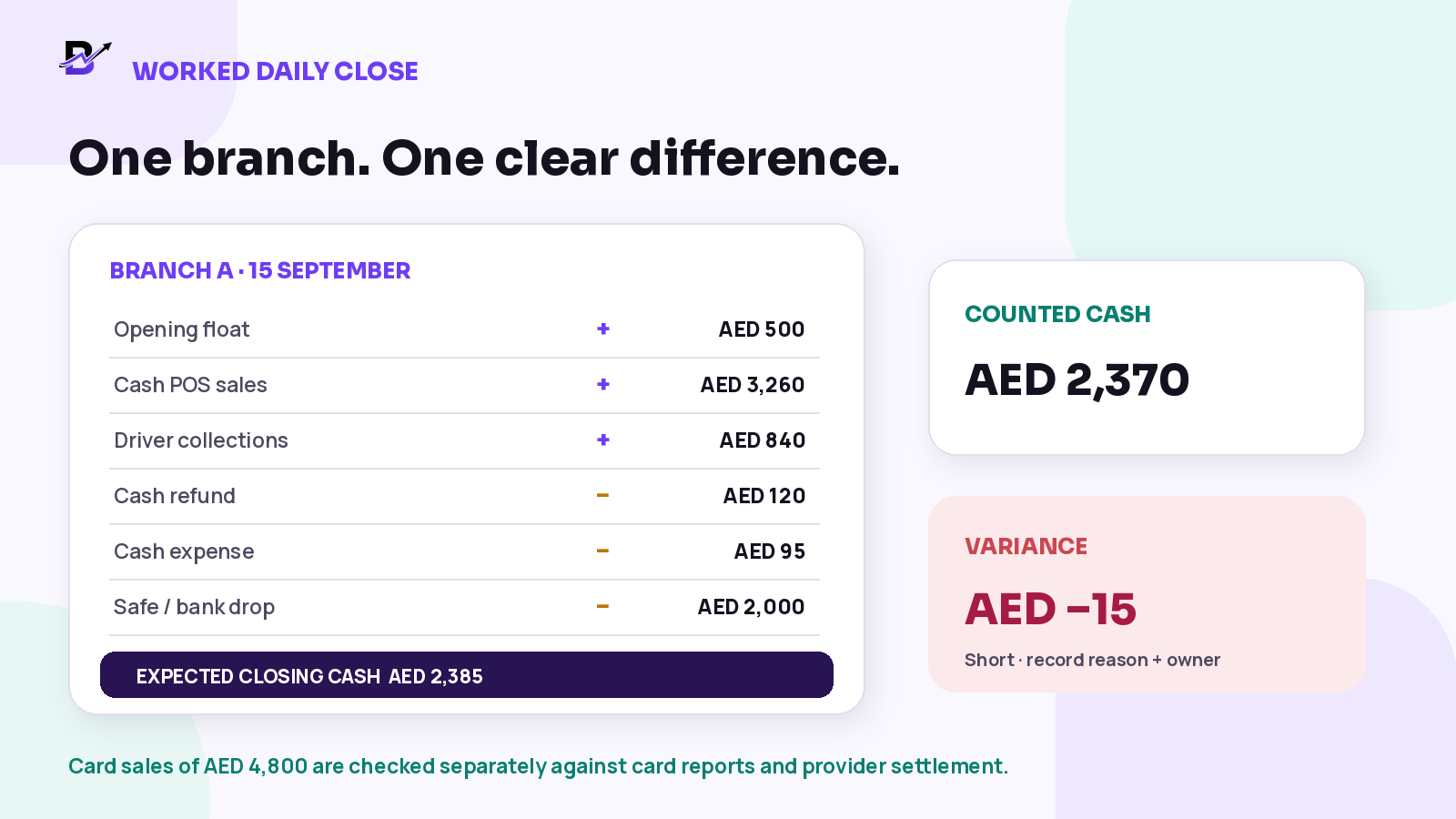
Figure 3. The example keeps cash movements separate from card sales and leaves the AED 15 shortage visible for review.
MOVEMENT | AMOUNT | MEANING |
|---|---|---|
Opening float | + AED 500 | Starting change money |
Cash POS sales | + AED 3,260 | Counter customers paid cash |
Driver collections | + AED 840 | Drivers handed over collected cash |
Cash refund | − AED 120 | Refund paid physically in cash |
Cash expense | − AED 95 | Approved expense with receipt |
Safe / bank drop | − AED 2,000 | Cash moved out of the drawer |
Expected closing cash | AED 2,385 | What should physically remain |
Counted cash | AED 2,370 | What staff actually counted |
Variance | AED −15 | Short cash requiring a reason and review |
The branch also processed AED 4,800 in card sales. That amount belongs in the card payment report and later provider or bank settlement review. Adding it to expected drawer cash would create a false shortage.
The AED 15 difference should remain visible. The manager should recheck the count, payment-method entries, refunds, expenses, cash drops and handovers. If the reason is found, record the correction or explanation. If it remains unresolved, assign a follow-up owner and keep it in the variance log.
Reconcile each cash holder separately
Reconcile the balance of each till, driver, petty-cash holder and safe separately. A recorded transfer moves responsibility from one holder to another; it does not create more business cash. Outstanding driver cash can remain open after the branch drawer closes, with a named holder and next handover.
CASH HOLDER | TYPICAL MOVEMENTS | CLOSING REQUIREMENT |
|---|---|---|
Counter till | Opening float, cash sales, cash refunds, paid-in and paid-out movements. | Count the drawer, compare with expected and record the next float or removal. |
Driver or delivery staff | Opening change, cash collected, approved cash expense and handover. | Keep the balance with the driver until a receiving person confirms transfer. |
Petty cash holder | Opening balance, approved expenses, replenishment and receipts. | Count the remaining fund and identify unsupported or unposted expenses. |
Manager / safe | Cash received from tills or drivers, transfers, safe drops and bank bags. | Match every incoming handover and outgoing deposit or transfer. |
DOUBLE-COUNTING WARNING
Do not add driver collections to the shop drawer until the driver actually hands over the cash. Until then, the money belongs to the driver balance. The business total may include both holders, but the same cash must never appear in both.
Follow an eight-step daily closing workflow
Define the period and holders. State the branch, till or shift, closing time and every employee, driver or cash box included.
Complete the source records. Post cash sales, collections, refunds, approved expenses, additions, transfers and drops before calculating expected cash.
Settle each cash holder. Ask cashiers, drivers and petty-cash holders to complete their handover or declare the amount still held.
Check proof and references. Match expenses to receipts, driver cash to orders, refunds to approvals and cash drops to handover or deposit evidence.
Calculate expected balances. Produce one expected amount for each till, employee, driver, branch or safe.
Count the physical cash. Count notes and coins by holder. For higher values, use a second count or manager verification according to policy.
Record and review variance. Compare counted with expected. Add the reason if known, assign an owner and preserve the original close and any later correction.
Secure cash and close the report. Leave the approved next float, move remaining cash into the safe or bank process, sign off and keep the report for owner review.
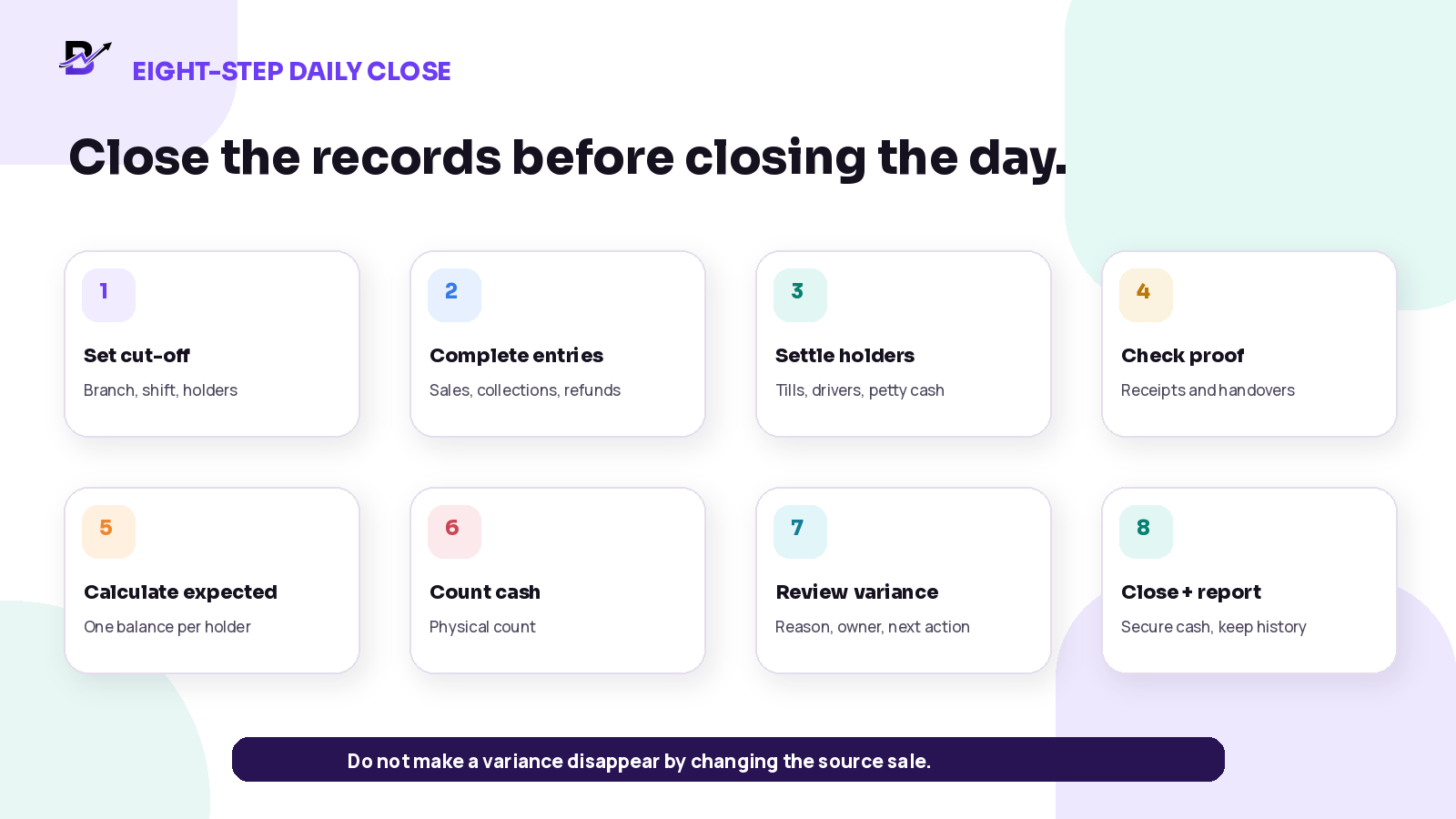
Figure 4. The close moves from completed records to counted cash, variance review and a secure handover.
Treat driver collections as a separate settlement
Delivery cash can create confusion because the order may be complete before the money reaches the branch. Keep the driver balance separate until the actual handover is confirmed.
DRIVER BALANCE FORMULA
Driver cash expected = opening change fund + cash collected − approved cash expenses − cash handed over. A confirmed handover reduces the driver balance and increases the receiving holder balance.
STAGE | WHAT HAPPENED | CONTROL |
|---|---|---|
Assigned for delivery | The order may require cash collection. | No cash is held yet; keep the expected amount linked to the order. |
Cash collected | The driver receives the approved amount. | Increase the driver’s cash-in-hand balance and record collection state. |
Partial or incorrect amount | Customer pays less, overpays or a dispute occurs. | Record the exception and contact the authorised team. |
Handover to branch | Driver passes cash to the receiving person. | Reduce driver balance and increase the receiving holder once confirmed. |
Late settlement | Driver still holds cash after the cut-off. | Keep it open under the driver with amount, time, reason and next owner. |
If the driver returns the next morning, do not quietly move the collection into the previous drawer count. Close the earlier period with the driver balance outstanding, then record the actual handover when it occurs.
Keep card and online payments outside the cash count
A payment report should show every method, but only physical cash belongs in the cash count. Card, wallet, bank-transfer and gateway payments normally settle through providers or bank accounts, often after fees, refunds, chargebacks or timing differences.
PHYSICAL CASH CLOSE | CARD OR GATEWAY REVIEW |
|---|---|
Opening float, cash sales, driver collections, cash expenses, refunds, drops, counted cash and variance. | POS or order payment total, terminal or provider report, refunds, fees, chargebacks, payout batch and bank receipt. |
A practical retail close can confirm the day’s card total against the POS or order report, then let finance reconcile provider payouts to the bank separately. One provider payout can contain several transactions and adjustments, so it may not equal one day’s gross card sales.
For examples of drawer sessions and payout checks, see Square’s cash drawer guidance, Shopify POS register sessions and Stripe payout reconciliation.
Give every role one clear responsibility
ROLE | MAIN ACTIONS | ACCOUNTABILITY |
|---|---|---|
Cashier / counter staff | Use the correct payment method, record refunds and paid-in or paid-out cash, protect the drawer and count the closing amount. | Own the accuracy of the assigned till or session. |
Driver / collecting staff | Record cash collected, protect it, report exceptions and complete handover. | Own cash until a receiving person confirms transfer. |
Branch manager | Review movements and proof, verify counts, approve or escalate differences and close the branch. | Own the operational close and unresolved actions. |
Owner / finance / operations | Review branch and staff trends, old variances, missing proof and settlement timing. | Own policy, thresholds, investigation and wider accounting follow-up. |
ACCESS RULE
Staff should see and edit only the cash activities needed for their role. A cashier does not need full owner reports, and a driver should not be able to alter another person’s balance.
Investigate variances without destroying the history
A cash variance is a signal, not a complete explanation. Start with the process before making assumptions about the person. Recount cash, review payment methods and check whether an entry was recorded in the wrong place or at the wrong time.
ISSUE | IMMEDIATE RESPONSE | KEEP IN THE RECORD |
|---|---|---|
Till is short | Recount by denomination; review cash sales, refunds, expenses and drops. | Amount, count time, reviewer, possible cause and next owner. |
Till is over | Check for a missed sale, paid-in amount or wrong opening float. | Do not create a fake sale just to remove the overage. |
Sale recorded as card instead of cash | Correct the payment method through the approved process. | Keep the original transaction and correction history. |
Cash expense has no receipt | Request evidence or manager explanation; leave it open if policy requires. | Amount, category, staff, reason and proof status. |
Driver has not settled | Confirm amount, current holder and agreed handover time. | Outstanding age, driver, affected orders and escalation. |
Cash drop is missing | Verify the safe, bag or deposit handover. | Source, destination, amount, time and evidence. |
Opening float was wrong | Verify the previous close and actual start count. | Use a visible opening correction—not a sales edit. |
FAIR PROCESS
A variance alone does not explain its cause. Recheck the records and follow written company policy and applicable local requirements before any staff or payroll decision; seek qualified advice when needed.
Track a small set of useful cash-control metrics
METRIC | SIMPLE DEFINITION | WHAT IT REVEALS |
|---|---|---|
Cash variance amount | Counted cash − expected cash, by holder and branch. | Size and direction of each difference. |
Variance rate | Absolute variance ÷ total cash handled, using one consistent definition. | Comparison across branches with different volumes. |
Unresolved variance age | Time since a difference was recorded without final outcome. | Stops old issues from being forgotten. |
Proof completion | Share of expenses, refunds and handovers with required evidence. | Where documentation is weak. |
Daily close time | Time from cut-off to reviewed and signed-off close. | Missing records or slow handovers. |
Late driver settlements | Collections not handed over by the agreed cut-off. | Delivery cash-control risk. |
Manual corrections | Changes made after close, grouped by reason. | Training, configuration or process problems. |
Do not copy a generic “perfect variance” target from another retailer. Establish the current pattern, define which differences require immediate review and improve the repeated causes. A small recorded difference is safer than a false zero created by editing records.
How Bloomlytix supports operational cash control
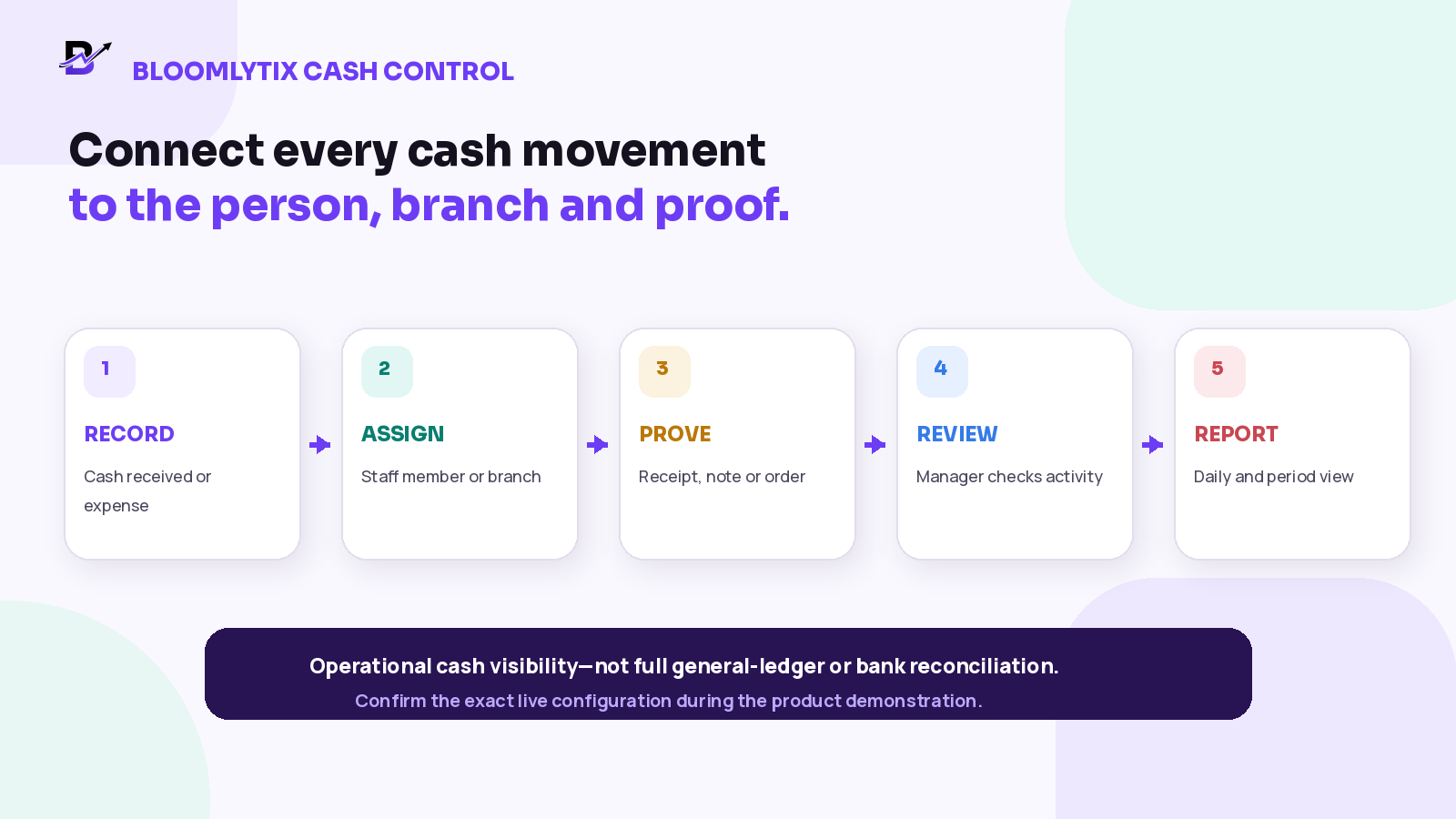
Figure 5. Bloomlytix can connect cash activity to staff, branches, evidence and reports inside the wider retail workflow.
Bloomlytix’s documented cash workflow records cash received and expenses against staff or branches, with notes, categories, dates and receipt proof where appropriate. Owners and managers can review cash activity and period reports in the wider retail operation. The exact live fields, permissions and closing workflow should be checked in a demo. See the Bloomlytix features for the broader product context.
BLOOMLYTIX AREA | PRACTICAL ROLE |
|---|---|
Cash received | Record cash received from customers, POS sales, manual payments or delivery collections. |
Expenses | Record amount, category, note, date, staff member and receipt image or other proof. |
Cash in hand | Review cash held by an employee or branch instead of relying on separate messages. |
Manager review | Let an owner or manager review daily cash activity and supporting records. |
Reports | Review daily, weekly and monthly cash activity alongside operational reports. |
Connected context | Review staff and branch cash activity alongside the related order, POS and delivery reports. |
PRODUCT SCOPE
Bloomlytix supports operational cash tracking and period reports. Confirm the live closing workflow during a demo. A complete general ledger, automated bank reconciliation, statutory accounting and audit compliance require separate systems or qualified processes.
The exact fields, permissions and closing process should be confirmed during onboarding. Businesses should also decide which accounting platform, payment providers, bank records and qualified advisers remain part of the wider financial-control process.
Questions to ask during a cash-control software demo
Can the system keep counter cash, driver cash and petty cash under separate holders or balances?
Can every cash received or expense entry show branch, staff, date, category, note and evidence?
How does a POS cash sale affect the assigned till or employee balance?
How are cash refunds separated from card or gateway refunds?
Can a driver collection remain under the driver until a confirmed handover?
Can a manager see expected cash, counted cash and variance without editing source transactions?
Can users record cash drops and transfers with source and destination?
Which permissions control cash entry, review, correction and report access?
Can reports show cash by branch, employee, driver, period and reason?
What belongs in Bloomlytix, and what remains in accounting or bank reconciliation?
Frequently asked questions
What is daily retail cash reconciliation?
It is the process of calculating how much physical cash should be held, counting the actual cash and recording the difference. The calculation normally begins with opening cash, adds cash received and subtracts cash paid out or transferred.
How do driver cash collections enter the close?
Keep collections under the driver until the money is handed to a branch, manager or safe holder. Record the handover once, reducing the driver balance and increasing the receiving balance.
Should refunds and cash expenses be recorded separately?
Yes. A refund relates to a customer order and reverses a payment. A cash expense is an operational payout. Both reduce cash when paid physically, but they need different reasons, evidence and reporting.
What should happen when the till is short?
Recount the cash, review payment methods, refunds, expenses, drops and opening float, then record the unresolved amount with a reviewer and follow-up owner. Do not hide it by changing sales.
Can a small shop reconcile cash without complex accounting software?
Yes. A small shop can use a disciplined opening count, movement log, closing count, variance record and manager sign-off. Connected software becomes more useful as staff, branches, drivers and order channels grow.
Daily retail cash closing checklist
☐ Closing period and branch are clear
☐ Every till, driver and petty-cash holder is identified
☐ All cash sales and manual collections are posted
☐ Cash refunds are linked to the correct orders
☐ Cash expenses have category, note and proof
☐ Cash additions, drops and transfers are recorded
☐ Expected balance is calculated for each holder
☐ Physical cash is counted and verified
☐ Variance has reason, owner and next action
☐ Next float, safe handover or bank drop is recorded
☐ Manager has reviewed and closed the day
Close the cash story—not only the sales report
A useful daily close explains where the money came from, who held it, what left the balance, what was counted and what still needs action. The aim is not to force every day to show a perfect zero. The aim is to make every difference visible, understandable and owned.
Start with one branch and one real day. Separate cash from card. Separate the till from the driver. Keep proof with the movement. Record the counted amount honestly. Then use repeated exceptions to improve training, permissions and daily routines.