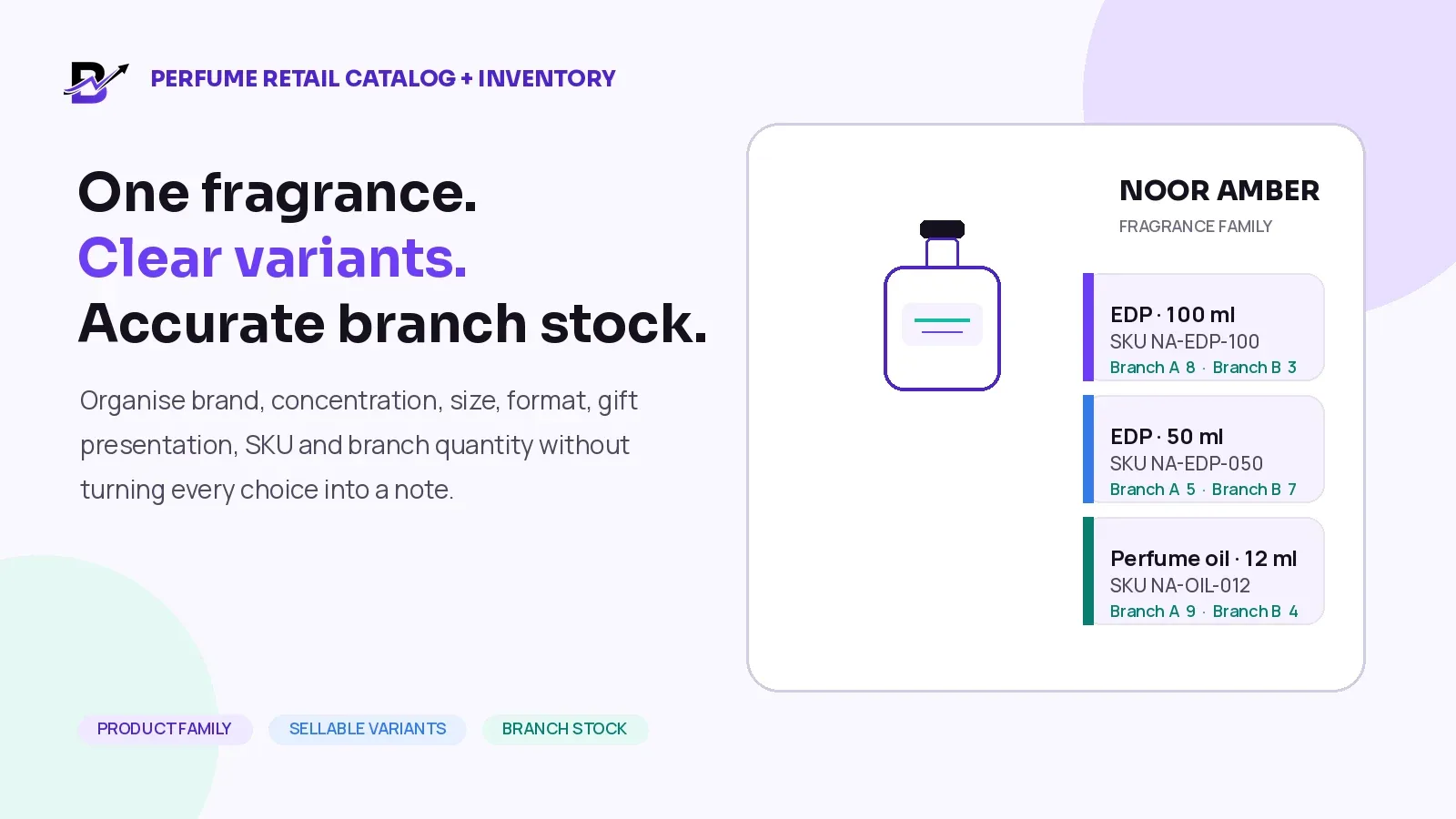
One fragrance name may be shared. Each concentration, size or format still needs a clear sellable record.
A customer may see one fragrance name. The business may need to manage six or ten different sellable records behind it: Eau de Parfum and Eau de Toilette, 50 ml and 100 ml bottles, perfume oil, a travel size, a discovery set and a gift box. Each can have a different price, barcode, supplier cost, branch quantity and online availability.
The problem begins when those choices are hidden inside product titles, notes or staff memory. A customer selects 100 ml, the POS shows only the fragrance name, the warehouse receives a different size, and the owner sees one total quantity that cannot explain which branch can actually complete the sale.
Direct Answer — Manage perfume inventory by separating the parent fragrance from each sellable variant. Store shared facts such as brand, fragrance name, collection and approved imagery at the product-family level. Give every concentration, size or format its own SKU or identifier, price, channel status and branch quantity. Track gift sets, discovery sets, testers, packaging and add-ons according to how they are bought, assembled and sold. Then connect purchases, receiving, online orders, POS sales, transfers, damage, returns and physical counts to the same records.
This guide is for perfume boutiques, fragrance brands, oud and attar shops, gifting businesses and multi-branch retailers that sell through ecommerce, customer apps, POS, assisted orders, pickup or delivery.
In this guide
Why perfume inventory is more complex than one product name and one quantity
How to separate a fragrance family from concentrations, sizes and formats
Which product facts belong at the shared level and which belong to each variant
How to use SKUs, barcodes and GTINs without confusing the product database
How to control gift sets, discovery sets, testers, packaging and add-ons
How purchases, receiving, branch transfers, sales, returns and counts should move stock
How ecommerce and POS can use one approved catalogue without showing wrong availability
Which metrics and review routines help owners identify slow-moving variants and stock differences
Where Bloomlytix fits and which specialist fragrance controls should be confirmed separately
Why perfume inventory becomes difficult
Perfume retail looks simple at the shelf: one bottle, one box and one price. Operationally, the same fragrance can exist in several concentrations, sizes, packaging formats and promotional sets. The customer may care about scent and presentation. The team must also care about the exact sellable unit.
CUSTOMER-FACING CHOICE | OPERATIONAL RECORD NEEDED | WHAT GOES WRONG WHEN IT IS UNCLEAR |
|---|---|---|
Fragrance name | Parent product or fragrance family | Several variants are mixed into one stock number. |
Concentration or format | EDP, EDT, parfum, cologne, attar, oil, mist or another verified label | Staff sell or describe a different product from the one selected. |
Bottle size / net content | 30 ml, 50 ml, 100 ml, 12 ml roll-on or another exact amount | A purchase or sale changes the wrong quantity. |
Gift presentation | Standard bottle, gift box, discovery set, seasonal set or wrapped order | The customer promise does not match the stock record. |
Sales channel | Website, app, POS, manual order or payment link | Prices and availability drift across channels. |
Branch | The exact shop, kiosk, warehouse or fulfilment point | A company total hides which location can fulfil the order. |
Core Principle — The customer can browse a fragrance family. The business must control the exact sellable variant.
Start with a product family and sellable variants
A clean catalogue separates the shared product identity from the records that can actually be priced, scanned, purchased and counted. This reduces duplicate content without combining stock that should remain separate.
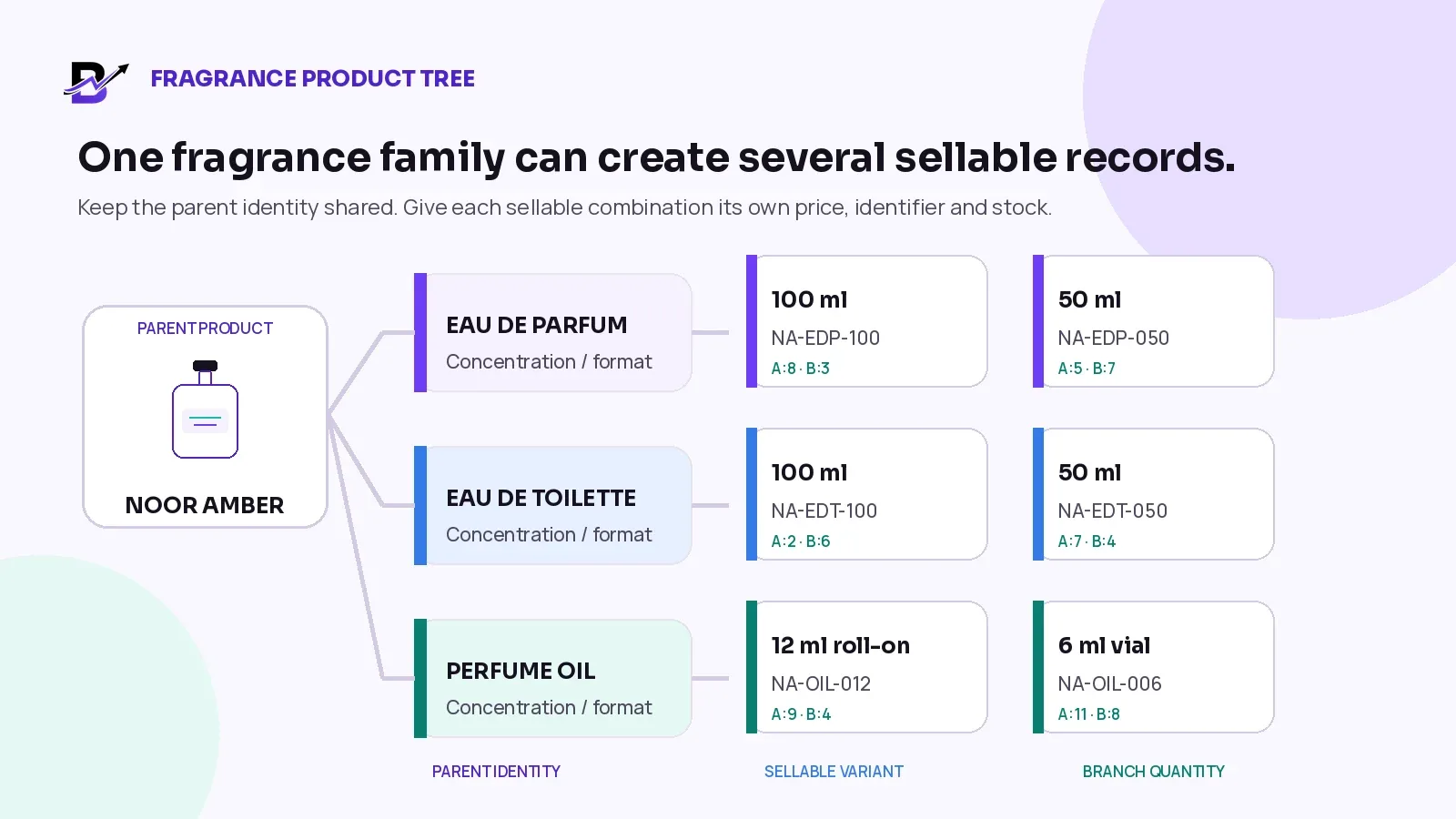
Figure 1. The parent product carries the shared identity. Each sellable concentration and size carries its own commercial and stock record.
CATALOGUE LEVEL | EXAMPLE | RECORD RULE |
|---|---|---|
Product family | Noor Amber | Use one parent identity for the approved brand, fragrance name, collection, description and shared media. |
Concentration / format | Eau de Parfum, Eau de Toilette, perfume oil | Use the exact product-label or manufacturer term. Do not rewrite one format as another. |
Size / net content | 100 ml, 50 ml, 12 ml | Treat a different sellable size as a separate variant. |
Sellable variant | Noor Amber EDP 100 ml | Give it its own SKU or internal ID, price, barcode/GTIN where available, channel status and stock. |
Location quantity | Downtown: 8; Mall: 3 | Track on-hand, reserved, unavailable and available-to-sell quantity by branch where the workflow supports them. |
Use verified concentration and product facts
Terms such as Eau de Toilette, Eau de Parfum, cologne and perfume extract are widely used on fragrance labels, but they are not fixed by one universal international concentration standard. Typical industry ranges exist, yet actual formulation and naming can vary by brand and market. A retailer should therefore copy the verified label and supplier or manufacturer record instead of guessing the concentration percentage.
Official reference checked 17 September 2026: IFRA fragrance descriptor guidance.
Do Not Infer — A bottle photo or product name cannot prove concentration percentage, ingredients, authenticity, batch, expiry, volume or regulatory information. Use approved manufacturer, supplier or brand records for those facts.
Build one complete perfume product record
A complete product record should let customers understand what they can buy and let staff recognise exactly what they are selling, receiving or counting. Shared facts should not be copied into every size unless the variation genuinely changes them.
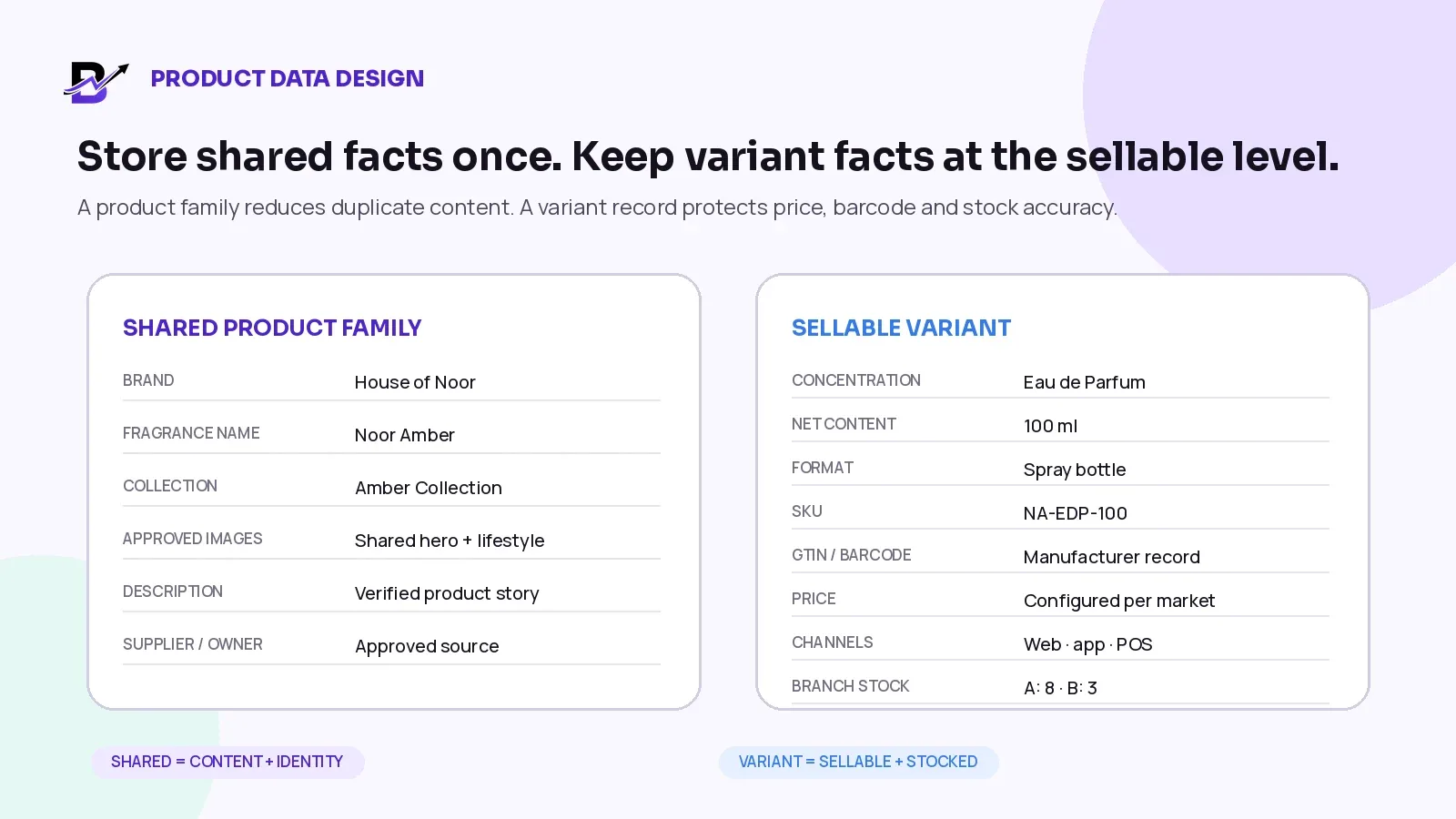
Figure 2. Store the common product story once, then keep price, identifiers and inventory at the sellable-variant level.
FIELD GROUP | WHAT TO RECORD | SOURCE OF TRUTH |
|---|---|---|
Identity | Brand, approved fragrance name, line or collection, product type | Brand owner, authorised supplier or approved catalogue record |
Customer content | Approved title, description, images, visible notes, use or occasion wording | Brand-approved content and retailer merchandising review |
Variant | Concentration/format, net content, bottle or applicator type | Packaging label and supplier/manufacturer specification |
Identifiers | Internal product ID, variant ID, SKU, supplier code, GTIN/barcode where supplied | Retail system plus verified supplier or GS1 record |
Commercial | Selling price, cost, tax configuration, discount eligibility, active channels | Approved price list and business configuration |
Inventory | Branch, on-hand, reserved, unavailable, available-to-sell, low-stock level | Inventory movement history and physical counts |
Order context | Gift wrapping, card, recipient, pickup/delivery, special instruction | Customer-approved order record |
Give every sellable variant a stable SKU or identifier
The visible product name is written for people and may change. Stock, imports, barcodes and reports need stable identifiers. A useful hierarchy is: one parent product ID for the fragrance family, then one variant ID and one unique SKU for every sellable concentration-and-size combination.
IDENTIFIER | PURPOSE | IMPORTANT RULE |
|---|---|---|
Parent product ID | Groups all variants under one fragrance family | Do not use it as the only stock identifier when sizes or concentrations are sold separately. |
Variant ID | Identifies the exact sellable combination inside the platform | Keep it stable even when the marketing title is improved. |
SKU | Helps staff search, import, report and reconcile the sellable line | Use a unique value and never reuse an old SKU for a different product. |
GTIN / barcode | Identifies a manufacturer-defined trade item for scanning and wider commerce | Use the verified code printed or assigned to that exact variant; do not invent a duplicate code. |
Supplier code | Matches the item used on supplier documents | Keep it separate when it differs from the retailer SKU. |
GS1 states that each product variation, such as a different size, needs its own unique GTIN when a GS1 identifier is used. The barcode identifies the item; the description, price and stock still live in the product database.
Official reference checked 17 September 2026: GS1 guidance on GTINs for product variations.
Organise perfumes, oud, attars and oils around the real sellable unit
Do not force every fragrance product into a spray-bottle structure. The product type should reflect what the customer buys and what staff count.
PRODUCT TYPE | USEFUL VARIANT FIELDS | PRACTICAL STOCK UNIT | CONTROL NOTE |
|---|---|---|---|
Perfume spray | Concentration, bottle size, edition, packaging | Bottle / boxed unit | Use the exact size and label term. |
Attar or perfume oil | Volume, applicator, bottle style, gift packaging | Bottle, vial or roll-on | Do not combine 6 ml and 12 ml stock. |
Oud product | Product form, weight/size, pack, origin or grade only when verified | Pack, bottle or other defined unit | Avoid unsupported quality, origin or authenticity claims. |
Body mist / spray | Volume, scent variant, pack | Bottle | Keep it separate from perfume concentration variants. |
Travel size / miniature | Volume, set membership, retail or promotional status | Unit or pack | Decide whether the item is sold, gifted or reserved for a set. |
Manage gift sets and discovery sets as real stock decisions
A gift set can arrive from the supplier as one finished product, or the shop may assemble it from several items. These two models should not use the same stock rule. Decide the model before selling the set online or at the counter.
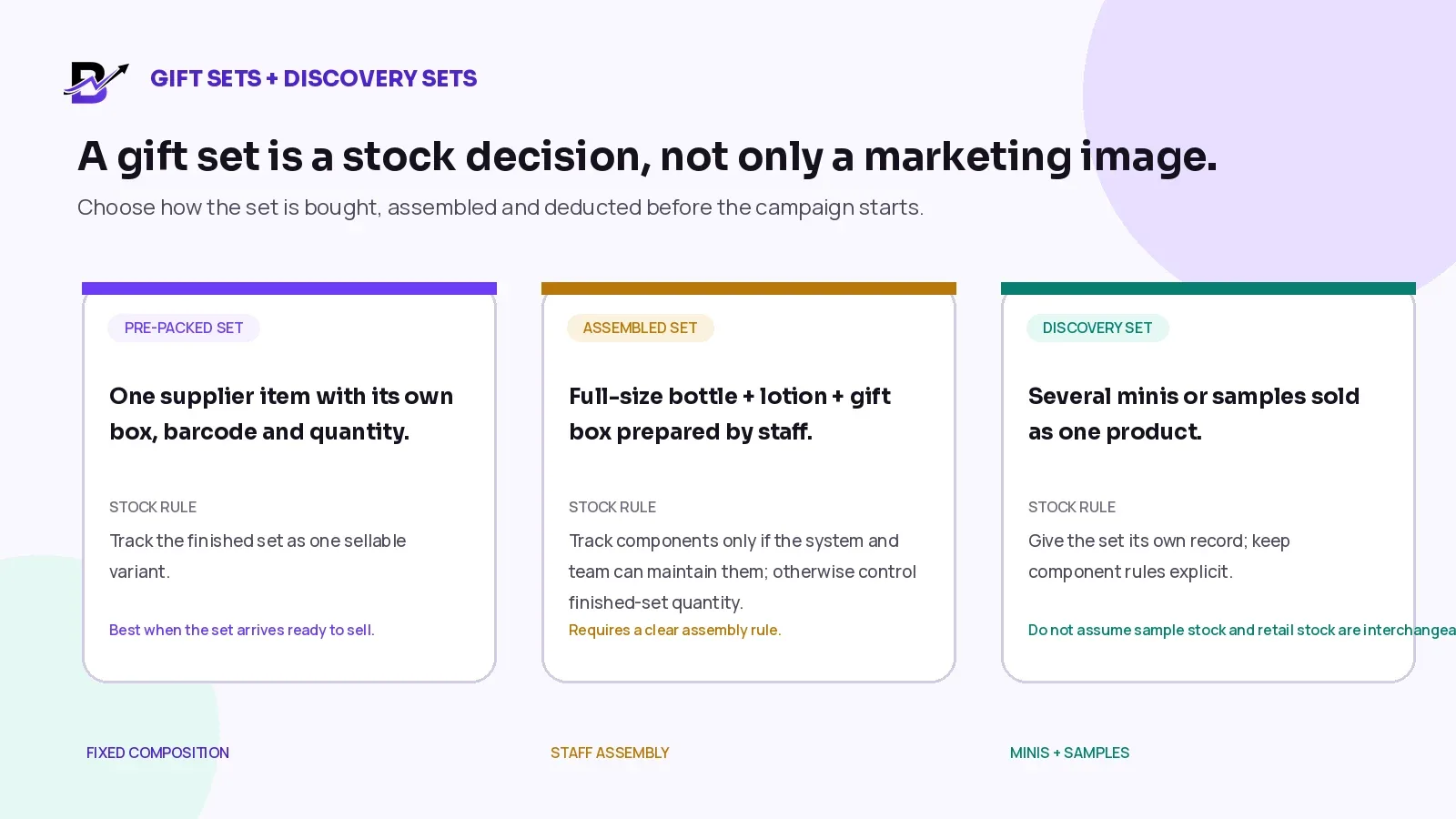
Figure 3. The stock model should match how the set is bought, assembled and replenished.
SET MODEL | RECOMMENDED OPERATING RECORD | MAIN RISK TO CONTROL |
|---|---|---|
Pre-packed supplier set | One finished product with its own supplier code, barcode/GTIN where provided, price and branch quantity | Opening the set or replacing a component without changing the record. |
Staff-assembled gift set | One sellable set plus a written assembly list; use component deduction only when the platform and team can maintain it reliably | Selling more sets than the available bottle, lotion, box or packaging can support. |
Discovery set | One sellable set with a fixed list of minis/samples and its own price and quantity | Using promotional samples as normal retail stock without a clear rule. |
Gift wrapping / card / bag | Separate add-on or packaging stock where cost or availability matters | Promising premium packing after a branch runs out of the required materials. |
GS1 treats a fixed assortment sold as one trade item as its own identified product, and a change to the included assortment can require a new GTIN.
Official reference checked 17 September 2026: GS1 predefined assortment rule.
Track testers separately from sellable stock
A tester may have the same fragrance and size as a retail bottle, but it has a different job. It is opened, used in the shop and normally cannot be sold as new stock. Keeping tester quantity inside the sellable count can create false availability.
TESTER CONTROL | PRACTICAL RULE | WHY IT MATTERS |
|---|---|---|
Separate status or item | Mark the unit as tester/non-sellable or move it to an unavailable stock group | Customers and POS should not see it as normal available stock. |
Opening / issue record | Record the branch, date, authorised user and reason when a sellable unit becomes a tester | The quantity change remains explainable. |
Location | Keep testers assigned to the shop or counter where they are used | A multi-branch owner can see which location holds them. |
Damage / empty disposal | Use a reasoned adjustment when the tester is damaged, lost or finished | The stock history shows the final outcome. |
Advanced consumption | Confirm whether the business needs volume-level use, batch, expiry or compliance tracking | These are specialist controls and should not be assumed from basic retail inventory. |
Scope Boundary — Bloomlytix can track configured tester items or adjustments in practical branch inventory. Exact tester consumption, batch/lot control, expiry, ingredient records and regulatory traceability must be confirmed during discovery.
Connect supplier purchases to the exact variant and branch
Purchasing should increase stock only when the correct item is received and accepted. A supplier invoice that says only “Noor Amber - 20 pieces” is not enough when the shipment contains several sizes or concentrations.
PURCHASE FIELD | WHAT TO RECORD | REVIEW QUESTION |
|---|---|---|
Supplier + invoice | Supplier, invoice number/date and attachment | Can the team trace the source document later? |
Receiving branch | The shop, kiosk or warehouse taking ownership | Did stock increase at the physical location that received it? |
Exact variant | Fragrance, concentration/format, size, supplier code, SKU/GTIN | Does the purchase line match the sellable record? |
Quantity received | Ordered, delivered, accepted, damaged and backordered quantities | Did the system add only accepted units? |
Cost + tax fields | Configured unit cost, subtotal, tax and total where required | Do operational records match the approved accounting process? |
Evidence + notes | Invoice image, delivery note, condition or discrepancy note | Can an owner explain a price or quantity difference? |
Define every important stock movement
Stock becomes trustworthy when the movement history explains each increase and decrease. The exact system labels can vary, but the business rule should remain clear.
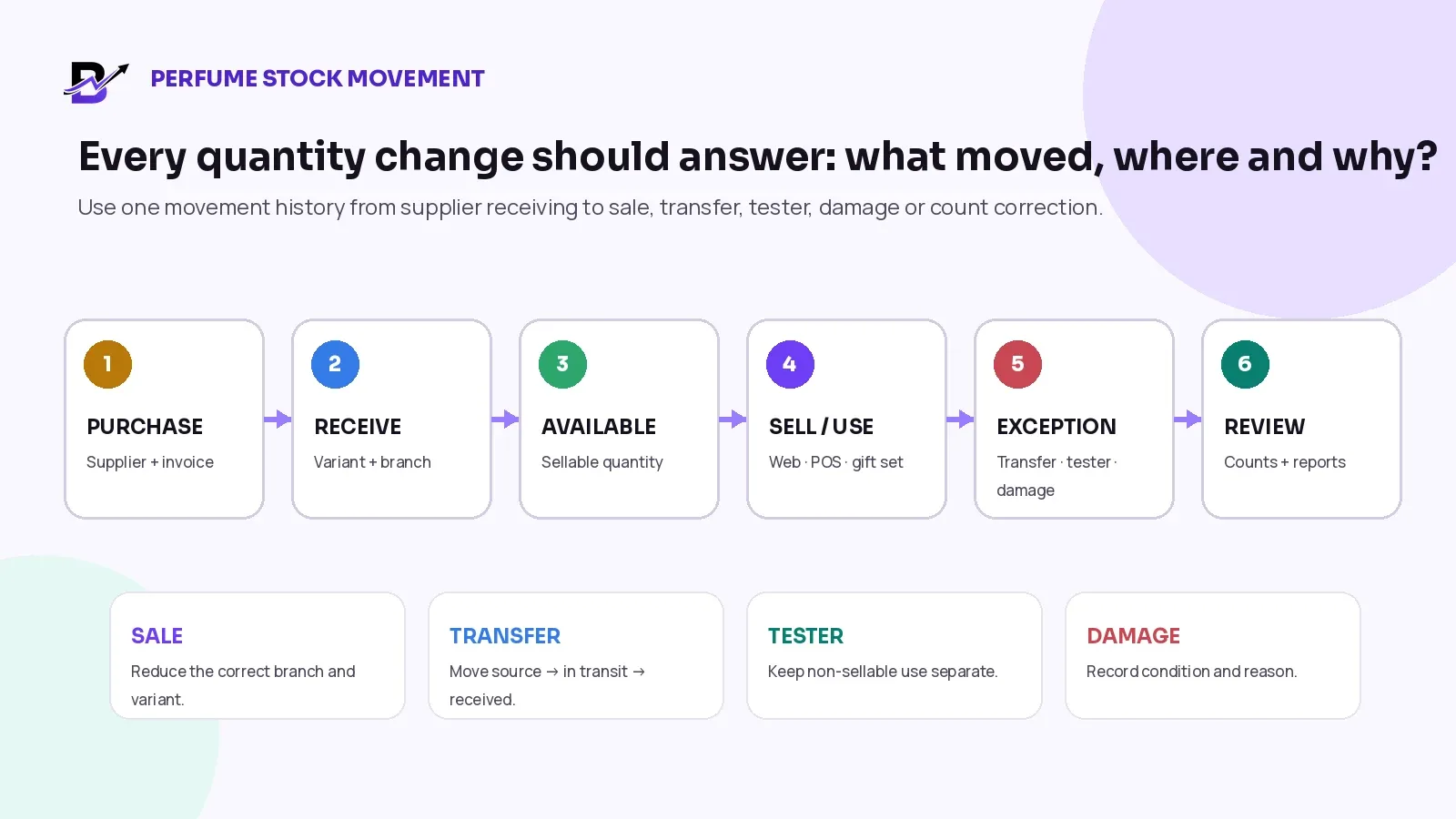
Figure 4. One movement history should connect supplier receiving, sales, operational use and exceptions.
EVENT | EXPECTED STOCK ACTION | EVIDENCE OR CONTEXT |
|---|---|---|
Supplier receipt | Increase the accepted quantity of the exact variant at the receiving branch | Supplier, invoice, line, received quantity and staff member |
Online / app order | Reserve or deduct the selected variant according to the approved order rule | Order, payment state, branch and configured deduction stage |
POS sale | Reduce the exact scanned or selected variant at the POS branch | Transaction, staff member, payment method and branch |
Manual / payment-link order | Use the same product and stock rule as other sales where configured | Order reference, approved price and fulfilment branch |
Gift set assembly | Reduce components or finished-set stock according to the chosen model | Assembly record, set quantity and staff owner |
Branch transfer | Move source quantity to in-transit, then receive it at the destination | Source, destination, sent, received, difference and status |
Tester issue | Move a sellable unit to tester/non-sellable status or adjust with a reason | Branch, user, date and tester reason |
Damage / leakage / loss | Remove from sellable stock and record the condition or reason | Photo or note where appropriate and manager review |
Return | Inspect first, then restock, hold or write off | Order, condition, destination branch and decision |
Count correction | Adjust only after the physical count difference is investigated | Count sheet, variance, reason and approver |
Manage branch stock and transfers
A total of eleven bottles across the company does not tell the customer whether the nearest branch has the selected 100 ml EDP. Track quantities by location and attach every sale, receipt, transfer and adjustment to the branch that owns the movement.
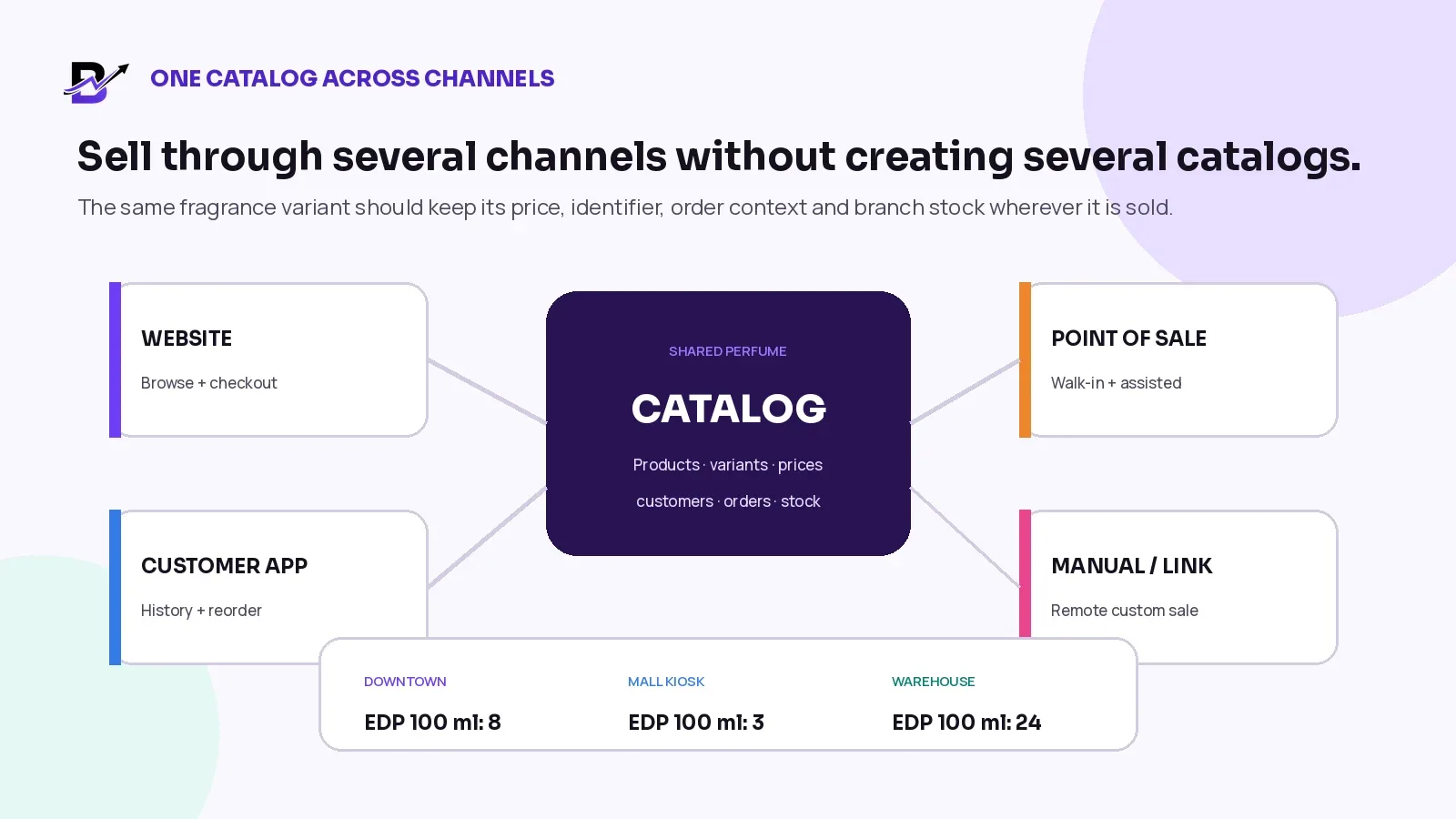
Figure 5. Several sales channels can use one approved variant record while each branch keeps its own quantity.
Working Formula — Available to sell = on hand - reserved - unavailable - any approved safety buffer. The exact labels and calculation depend on the platform and business rules.
Use a traceable transfer rather than subtracting from one spreadsheet and adding to another. A simple status flow is: requested -> approved -> sent -> in transit -> received or partially received -> closed. Record any missing, damaged or rejected quantity before the transfer is completed.
Use one catalogue across ecommerce and POS
The website, customer app, POS and assisted-order team should recognise the same sellable variant. A customer who chooses EDP 100 ml online should create the same product identity that staff search or scan at the counter.
CHANNEL DECISION | CONNECTED RULE |
|---|---|
Product visibility | Decide which family and variants are active on the website, app and POS without creating duplicate products. |
Variant selection | Show concentration, size and format as structured choices rather than hiding them in notes. |
Price + offer | Use the approved price and channel-specific promotion only when the difference is intentional. |
Stock location | Attach the sale to the branch or fulfilment location that owns the quantity. |
Customer history | Keep permitted online, POS and assisted purchases connected to the customer record where appropriate. |
Order fulfilment | Carry gift wrapping, recipient, message, pickup/delivery and staff instructions into the same order. |
SEO note for perfume product variants
For sellable ecommerce pages, Google supports Product and ProductGroup structured data for product variants. Each variant should have a unique identifier such as an SKU or GTIN in the markup, and the site should be able to preselect the exact variant with a distinct URL or URL state that shows the matching image, price and availability. The visible page, structured data and Merchant Center feed should agree.
Official references checked 17 September 2026: Google product variant structured data · Google ecommerce URL guidance.
Keep premium packing, recipient details, pickup and delivery attached to the order
Perfume is often bought as a gift. The stock record answers what was sold. The order record must also protect how it should be presented and handed over through pickup or delivery.
ORDER DETAIL | WHAT STAFF SHOULD SEE | COMMON RISK |
|---|---|---|
Selected variant | Exact fragrance, concentration/format and size | A similar bottle is prepared instead. |
Gift presentation | Gift box, wrapping, bag, ribbon, card and add-ons | The premium presentation is promised but unavailable. |
Message / recipient | Exact customer-approved message and permitted recipient details | A note is copied incorrectly or the surprise is spoiled. |
Payment | Paid, pending, cash/card/POS/link or another approved state | Preparation starts under the wrong payment assumption. |
Pickup | Branch, date, ready time and authorised pickup person where required | The order is completed at the wrong branch or time. |
Delivery | Zone, charge, address, date, slot, access notes and proof requirement | The driver receives a location with no product or timing context. |
Count, review and replenish with a practical routine
A catalogue structure is only useful when recorded stock is checked against reality. Count high-value and fast-moving variants more often, investigate important differences, and set low-stock levels around actual demand and supplier lead time.
RHYTHM | RECOMMENDED CHECKS | OWNER QUESTION |
|---|---|---|
Daily | Review negative stock, last-unit sales, failed orders, high-value adjustments, open transfers and missing tester records | Is any urgent difference blocking a customer promise? |
Weekly | Count critical variants, review low stock, receiving differences, slow movers and branch availability | Which variants need replenishment, transfer or promotion? |
Monthly | Complete cycle counts, compare purchases to sales, review gift sets, add-ons, tester changes and adjustment reasons | Where is cash tied up or control becoming weak? |
Peak / campaign | Confirm campaign variants, set branch allocation, packaging, quantity caps and delivery limits | Can every promoted item be fulfilled safely? |
Use metrics that reveal the exact variant and branch
Avoid generic benchmarks that do not match the brand or market. Build a baseline from your own product range and review the cause behind the number.
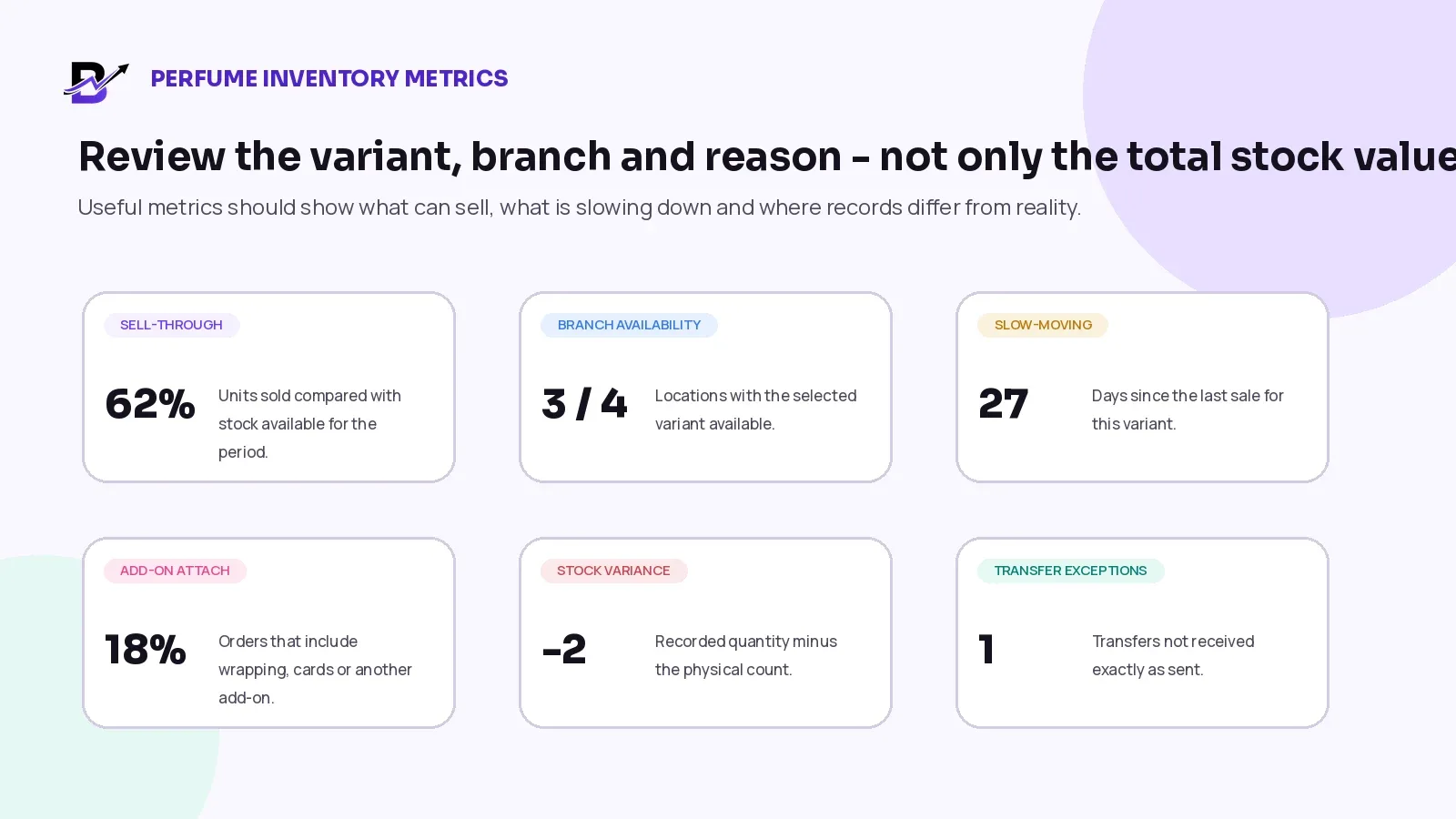
Figure 6. Useful perfume metrics stay specific to the variant, branch, channel and movement reason.
METRIC | SIMPLE DEFINITION | WHAT IT CAN REVEAL |
|---|---|---|
Sell-through by variant | Units sold during the period divided by the units made available during the period, using one consistent method | Which size or concentration is moving and which is tying up stock. |
Branch availability | Number or percentage of selling locations with the chosen variant available | Whether stock is concentrated in the wrong location. |
Slow-moving age | Days since the last sale or another agreed ageing measure | Which variants need transfer, merchandising or purchase restraint. |
Gift-set performance | Units sold, remaining quantity and component constraint where relevant | Whether seasonal sets are working and which component limits them. |
Add-on attach rate | Orders containing gift wrapping, cards, bags or another configured add-on | Whether premium presentation options are being used. |
Stock variance | Recorded quantity minus physical count, by variant and branch | Where receiving, sales, testers, transfers or adjustments need review. |
Transfer exception rate | Transfers with a missing, damaged or different received quantity | Whether branch movement controls are reliable. |
How Bloomlytix supports the perfume-shop workflow
Bloomlytix is designed as one connected ecommerce and retail operating platform for perfume brands and shops. The same product, customer, order, branch, payment and operational context can support the website, eligible customer apps, POS, manual orders, staff fulfilment, inventory, purchases, delivery and reporting.
BLOOMLYTIX AREA | PRACTICAL ROLE IN THE PERFUME WORKFLOW |
|---|---|
Shared catalogue | Organise perfumes, oud, attars, oils, discovery sets, gift boxes, sizes, concentrations, formats and configured add-ons. |
Ecommerce + customer apps | Present products and structured options, capture customer/recipient details, offers, pickup or delivery and order history. |
POS + assisted sales | Process walk-in or remote sales from mobile, tablet or desktop using the connected catalogue and branch context. |
Branch inventory | Track configured product and add-on quantities, low-stock visibility, adjustments, transfers and movement history. |
Purchases + evidence | Record supplier purchases, branch, invoice details, totals and attachments for operational review. |
Staff fulfilment | Keep selected fragrance, size, concentration, gift presentation, message, payment and timing visible to permitted staff. |
Pickup + delivery | Connect order details to configured zones, dates, slots, driver assignment, status and proof. |
Owner reports | Review sales, product, branch, stock, purchase, cash, delivery and other configured reports. |
Product Scope — Bloomlytix supports practical product and branch stock, variations, purchases, sales, fulfilment and delivery. Confirm batch or expiry tracking, tester consumption, regulated ingredient records, authenticity verification, wholesale/distribution, manufacturing/formulation, serial-level traceability, marketplace synchronisation and custom integrations separately.
Bloomlytix product scope checked 17 September 2026: perfume shop platform · complete platform features.
Questions to ask during a perfume software demonstration
Can one fragrance family contain several concentrations, sizes and formats? Ask the vendor to show the exact parent/variant structure, not only a list of product names.
Does every sellable variant have its own identifier, price and branch stock? Test a 50 ml and 100 ml bottle with different quantities and prices.
Can the same approved catalogue serve the website, customer apps and POS? Change one variant and confirm how the permitted channels update.
How are gift sets and discovery sets controlled? Ask whether the business will track finished sets, components or a manual assembly rule.
How are testers kept out of sellable stock? Show a retail bottle becoming a tester and verify the movement history.
How are supplier purchases and receiving differences recorded? Use a real invoice with two sizes and a partial or damaged quantity.
Can branch transfers show sent, in-transit and received quantities? Test a partial receipt instead of a perfect transfer.
What happens when an online and POS sale compete for the last unit? Confirm the supported reservation, deduction and exception behaviour.
How are returns, damaged bottles and opened products handled? Separate the refund from the physical restock decision.
Can staff keep gift wrapping, message, recipient and delivery details with the selected variant? Follow one real gift order to pickup or proof of delivery.
Which reports are standard? Review sales by variant, branch availability, purchases, adjustments, gift sets and stock variance.
Which specialist requirements need extra scope? Confirm batch, expiry, tester-volume, compliance, wholesale, manufacturing and marketplace requirements in writing.
Frequently asked questions
How should perfume sizes and concentrations be organised?
Use one parent product for the shared fragrance identity, then create a separate sellable variant for every concentration-and-size combination. Each variant should have its own identifier, price, channel status and branch quantity.
Should each fragrance variant have its own SKU?
Yes, a unique SKU is strongly recommended for every sellable variant. It makes receiving, POS search, stock counts, imports and reports easier. If the manufacturer provides a GTIN/barcode, store the verified code for that exact variant rather than using one code across several sizes.
How should discovery sets and gift boxes affect stock?
First decide whether the set arrives as one finished supplier item or is assembled by staff. Track the finished set as one product when that is the real purchased and sold unit. Use component-level deduction only when the system and team can maintain the rule accurately.
Can online and POS sales share branch inventory?
Yes. One connected platform or a reliable integration can use the same variant and location model. The business still needs clear rules for fulfilment branch, reservation, deduction, failures, returns and physical counts.
How should testers and batch tracking be handled?
Keep testers separate from sellable stock and record when a unit becomes a tester. Batch, lot, expiry or volume-level tester consumption are deeper traceability requirements; confirm whether they are supported and necessary for your products and market.
Can AI create a perfume listing from a bottle photo?
AI can prepare a first draft for visible presentation, title, description, category, tags and SEO fields. A person must still confirm brand, fragrance name, concentration, volume, notes, authenticity, price, stock, variants and claims from approved records before publishing.
Perfume catalog and stock setup checklist
Create one parent record for the approved fragrance family.
Create a separate variant for every sellable concentration, size and format.
Use the exact label and manufacturer or supplier wording for concentration and net content.
Assign a stable variant ID and unique SKU; record the verified GTIN/barcode where available.
Keep price, cost, channel status and branch quantity at the sellable-variant level.
Separate perfumes, oils, attars, oud products, mists and travel sizes when their stock behaviour differs.
Choose a clear stock model for pre-packed sets, staff-assembled sets and discovery sets.
Keep testers and non-sellable stock separate from customer availability.
Record supplier, invoice, receiving branch, accepted quantity and evidence for purchases.
Define when online, app, POS and manual orders reserve or deduct stock.
Use traceable branch transfers with sent and received quantities.
Use reason codes for tester issue, damage, leakage, loss, return and count correction.
Attach gift wrapping, card, recipient, message, pickup or delivery to the order - not the product stock note.
Count critical and high-value variants regularly and investigate important differences.
Review sell-through, slow movers, branch availability, gift-set performance, add-on use and stock variance.
Keep product pages, structured data, price and availability consistent across the website and product feeds.
Confirm batch, expiry, regulated ingredient, authenticity, tester consumption, manufacturing and wholesale requirements separately.
Bring one real fragrance family to the demo. Choose one perfume with at least two concentrations or sizes, one gift set, two branches and a recent supplier purchase. Bloomlytix will map the product, POS, stock, fulfilment, pickup or delivery and owner-reporting workflow around that real example.
Book a tailored perfume-shop demo
Explore the connected workflow: Perfume shop software · Perfume ecommerce website · Perfume POS software · Perfume inventory software · Perfume delivery management · Book a demo.